I've spent about twenty years in marketing. The first stretch was at very large companies, Dell, IBM, Rackspace, then a few years at agencies, and most recently four years as VP of Marketing at Alloy, a Series A software company in a crowded AI category.
At the big companies, competitive intelligence was somebody's whole job. A team of people read every article, every newsletter, every social post from every competitor, summarized it, and pushed a digest out to like 400,000 employees. Most of it wasn't relevant to me. Too, high-level and not actionable. Or maybe it was I was too early in my career and not strategic enough.
That changed when I became Alloy's marketing VP. When I joined, our deals were mostly buy us or do nothing. Four years later, the same handful of competitors showed up in every single deal, and pricing pressure came with them. Somewhere in the middle of that I figured out that our bigger, better-funded competitors were tracking us with competitive intelligence tools, and we were tracking them with browser tabs and whatever a sales rep happened to mention on a Friday.
So I went looking for a tool. What I wanted was pretty simple: watch every channel that mattered, separate the signal from the noise, and tell me about the handful of things I actually needed to know. I didn't need to respond to everything a competitor did. I needed to know, and I needed a read on how my own team's marketing stacked up against theirs. What I found was Klue and Crayon at around $40K to $60K a year with long implementations, built for companies with a CI department and an enterprise procurement process. Nothing existed for a lean marketing team with a real budget but not that budget.
So I built it. And in the process I learned that competitive intelligence is about a lot more than listening to what competitors are doing. It's zooming out to see the whole market, then zooming in to find the specific openings you can use in your own marketing this quarter.
This guide is everything I wish I'd had at Alloy: what competitive intelligence actually is, where the signal lives, how to score what matters, and how a small team runs the whole thing in about ten minutes a day. No CI department required.
1. What is competitive intelligence?
Competitive intelligence (also called competitor intelligence, or just CI) is the ongoing practice of collecting what your competitors are doing across public sources, filtering it down to what actually matters, and using it to make better decisions about pricing, positioning, product and sales. The word that does the work in that definition is ongoing. A competitor analysis is a document. Competitive intelligence is a habit and a practice.
That's the competitive intelligence definition I'd put on a slide. In practice it looks like this: a competitor changes their pricing page on Tuesday, and by Wednesday morning your sales team knows about it and has a talking point ready. A competitor's CEO posts on LinkedIn about "AI-native" positioning, and your product marketer decides, on purpose, whether to follow or to go the other way. A prospect says "we're also looking at X," and nobody on your team is hearing that name for the first time.
What competitive intelligence is not
It is not the 40-slide competitor deck somebody built last spring. It's a battlecard collecting dust in a Google drive somewhere. That's competitive analysis, and it was accurate for about a month. It is not espionage; everything in this guide comes from sources your competitors publish on purpose, or that their customers publish about them. And it is not a Slack channel called #competitors where people paste links that nobody reads.
Competitive intelligence vs. competitive analysis vs. market research vs. business intelligence
These four get used interchangeably and they shouldn't be. The quickest way to keep them straight is by cadence and by what comes out the other end.
Competitive intelligence
Competitive analysis
Market research
Business intelligence
Cadence
Continuous, daily
Point in time, quarterly or annual
Project-based
Continuous
Looks at
What competitors are doing right now
How competitors compare on a fixed set of criteria
Customers, buyers, the category
Your own internal data
Inputs
News, reviews, social, website changes, ads, pricing, SEO
Feature lists, pricing pages, positioning
Surveys, interviews, analyst reports
CRM, product analytics, finance
Output
Alerts, digests, talk tracks, decisions
A deck, a matrix, a battlecard
A report
Dashboards
Owner at a small company
Whoever cares most (often marketing or the founder)
Product marketing
Marketing or product
Ops or finance
Business intelligence is the one people mix up most often, because both have "intelligence" in the name. BI is about your data. CI is about everyone else's. Market intelligence is the other near-neighbor: it covers the whole category, including buyers, trends and companies you don't track by name, while competitive intelligence covers a named set of rivals. You need both, and the second is where this guide lives.
Types of competitive intelligence
There are two axes worth knowing. The first is tactical versus strategic. Tactical CI is this week's stuff: a competitor launched a promo, changed a headline, ran a new ad. Strategic CI is the slower shift in the competitive landscape underneath, like a competitor quietly moving upmarket or pivoting to a new segment, which you usually only spot by looking at three months of tactical signals in a row.
The second axis is who uses it. GTM-facing CI feeds sales and marketing: battlecards, talk tracks, positioning, ad and content strategy. Product-facing CI feeds the roadmap. When one of our customers, GiveKit, saw a competitor sunsetting a program similar to their own, that intelligence reshaped GiveKit's free tier. That's product-facing CI, and it's the most valuable kind, because it changes what you build and not just what you say.
2. Why competitive intelligence matters more in 2026 than it did in 2020
At my last job, I got blindsided twice in one year. A competitor raised a round and I heard about it weeks later, from the CEO (this one hurts when you lead marketing). Another made an acquisition that changed who we were competing against, and I found out when sales started losing deals to the combined company. Both were public. Both were findable. I just wasn't looking in the right places at the right time, and that was in 2022, when things moved slower than they do now. Two things have changed since, and they compound each other.
Your competitors ship faster than you can watch
I was speaking to a VP-level engineering leader in Austin a few weeks back, and one thing kept coming up: that's how much more their teams ship since AI dev tools became the norm. The published numbers are more conservative but point the same way. McKinsey's study of 4,500 developers across 150 companies found routine engineering work takes 46% less time with AI tools, and Opsera's data from 250,000 developers shows time-to-pull-request falling by up to 58% (summary of METR, McKinsey and Opsera findings, 2026). A competitor that used to make one meaningful move a quarter now makes one a week, and a quarterly competitor review is stale before the deck is finished.
Competitive intelligence used to be an enterprise habit that could keep up with that pace, because the pace was slow. In Crayon's 2022 survey of 1,200 practitioners, only about a third of teams ran a dedicated CI platform and 57% described their CI function as "ad hoc" or "emerging" (Crayon, 2022). Ad hoc worked when your competitors shipped once a year. It doesn't now.
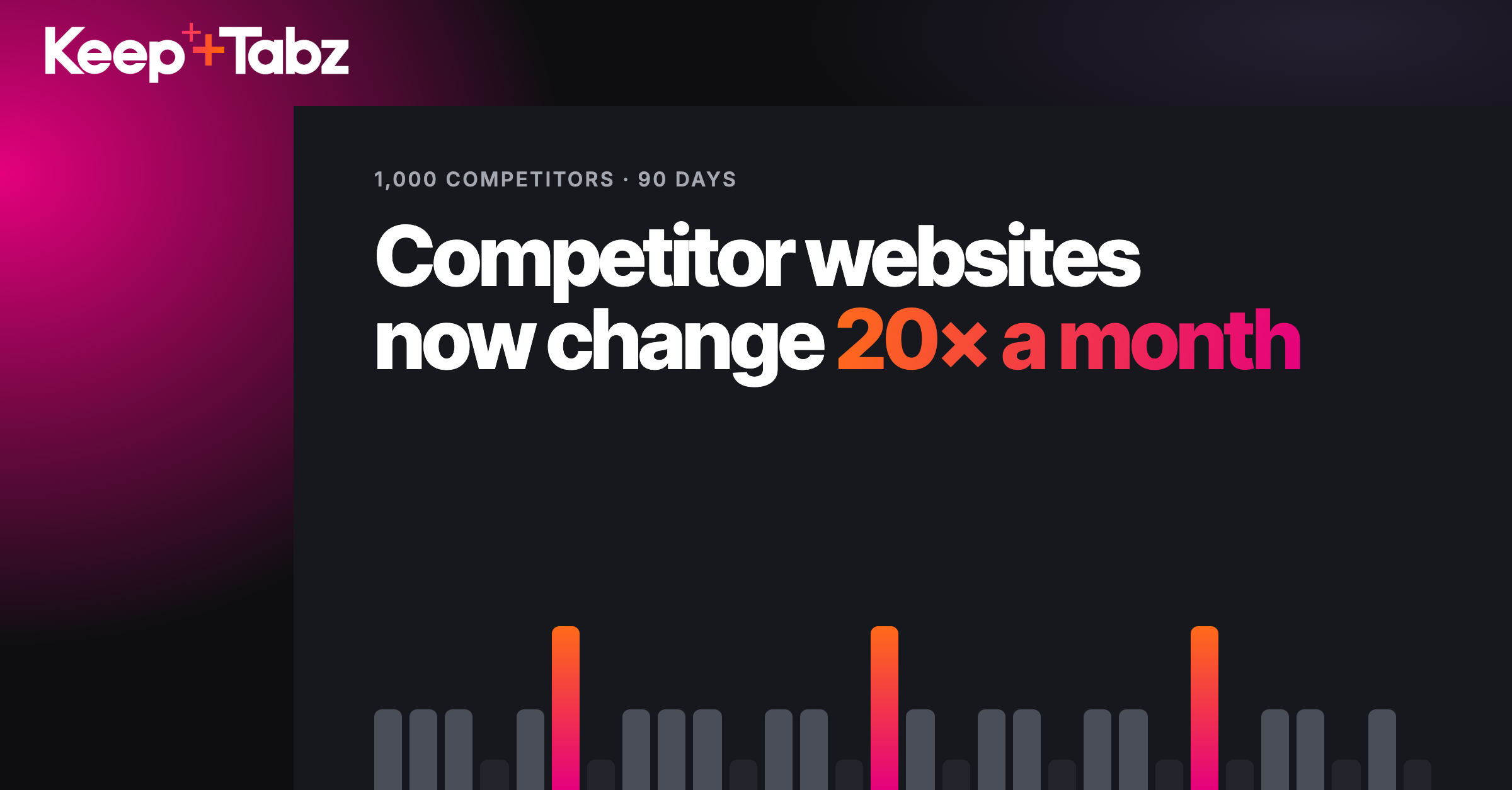
Our own crawler data says the same thing more bluntly. Across 102 software companies that KeepTabz customers tracked over the 90 days ending September 23, 2026, the average competitor changed a tracked page about 20 times a month, and roughly three of those changes a month were scored as high-impact: a pricing move, a launch, a repositioned headline. 87% changed their homepage at least once in the quarter. Half changed their pricing page, and the ones that did edited it six times on average. 39% changed their terms of service. If you check a competitor's site once a quarter, you're seeing one frame of a film.
There are more competitors than there used to be, and there will be more next year
The second reason is that software is getting cheaper to build, and when something gets cheaper to make, you get a lot more of it. Economists call this the Jevons Paradox: when steam engines got more efficient, England burned more coal, not less, because cheap power made a thousand new uses worth pursuing. Software is going through the same thing. My world, the marketing technology landscape, alone counted 15,384 tools in 2025, up 9% in a year, with 2,489 new tools added in twelve months (MarTech, 2025). A category that had five credible vendors in 2020 has fifteen now, plus a wave of AI-built point solutions that didn't exist eighteen months ago.
You can see it in the deal data. When Klue analyzed 3,400 B2B buyer interviews, only 1.5% of deals had no competitor involved, buyers evaluated 3.5 vendors on average, and more than 70% of deals had three or more competitors in the room (Klue, 2024). In Crayon's 2026 survey, 57.5% of teams said more of their deals were competitive than a year earlier, and seven in ten said at least half of their pipeline is now contested (Crayon, 2026). Revenue leaders estimate 21% of their deals are lost directly to competitors, and one in three of those losses was winnable (Klue, 2025).
The number I'd sit with is from that same Klue report: 47% of sales reps only find out which competitor they're up against at the negotiation stage or later, and only 30% of revenue leaders think their reps can demonstrate differentiated value in a deal. Everyone agrees the market got harder. Almost nobody thinks they're handling it well. And the fix is not complicated: teams that share competitive intel weekly or faster report a revenue impact 79% of the time, against 41% for teams that share monthly or less (Crayon, 2026). That gap is roughly the whole argument for doing this on purpose instead of by accident.
The short version: nobody can hold the picture of their market in their head anymore. Not the founder, not the PMM, not the CRO. Five years ago that was an inconvenience. Now it costs you business.
3. The competitive intelligence process for a team of three
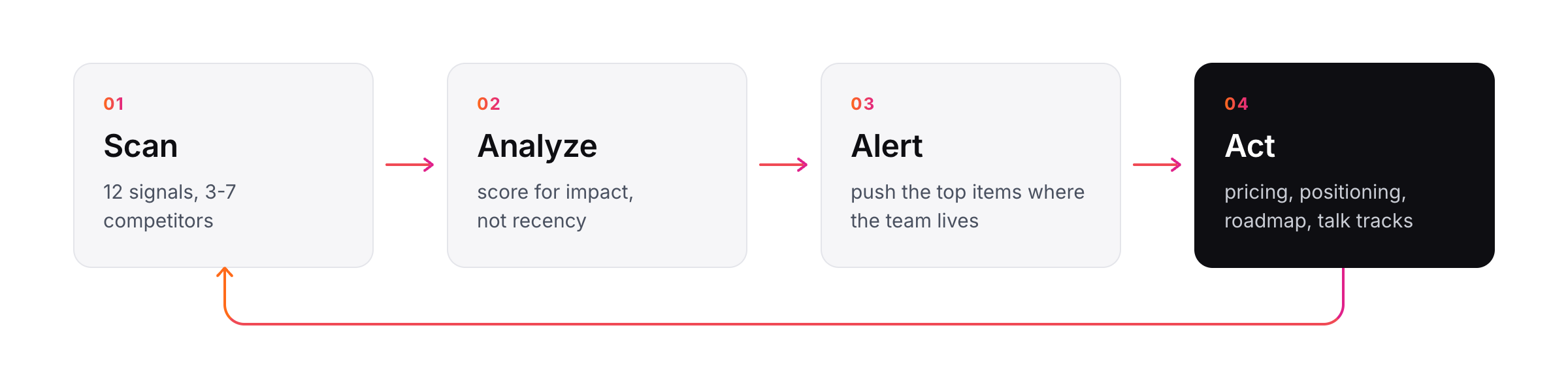
The competitive intelligence process is a loop. Four steps, repeated daily: scan the sources, analyze what came in, alert the people who need to act, and act. The whole loop should take about ten minutes a day for one person once it's set up. If it takes longer than that, you're either watching too many competitors or you haven't solved the filtering problem, and the filtering problem is the one that kills most CI efforts in month two.
One loop, run daily. The output of Act feeds the next Scan, because once you've made a decision, you know what to watch for next.
If you need a competitive intelligence framework for a deck, this is it. I'd rather you thought of it as a system.
By hand
With a tool
Where it breaks by hand
Scan
Spreadsheet, one row per competitor, one column per signal; ~2 hrs/week per competitor
Sources crawled daily into one inbox
Consistency: the schedule dies at the first launch
Analyze
Read everything, tag ignore / note / act
AI scores every item for competitive importance and shows its reasoning
Volume: after two weeks nobody reads everything
Alert
Friday Slack post by whoever ran the scan
Daily digest to Slack, Teams, Discord or email, top items only
Vacations, and the 40-item email nobody opens
Act
Ad hoc forwarding
Each item routed to pricing, positioning, roadmap or sales
The last step is never wired to a decision
Step 1: Scan
Competitor monitoring starts with picking three to seven competitors. More than that and the signal-to-noise ratio collapses; fewer and you'll miss the one that matters. Include at least one that's bigger than you, one that's roughly your size, and one that didn't exist two years ago. Then decide which of the twelve signals in the next section matter for your category. B2B SaaS cares about G2, LinkedIn exec accounts and pricing pages; a consumer brand cares about Google Reviews, organic Facebook and the Meta ad library. Nobody needs all twelve on day one.
By hand this is a spreadsheet and a schedule. With a tool, the sources land in one inbox and scanning becomes reading rather than hunting.
Step 2: Analyze
This is where most teams fail, and it's the step nobody talks about. The question isn't "what happened" but "does this change anything for us." A competitor posting a webinar reminder is not intelligence. A competitor's terms of service adding a clause about usage-based billing probably is. The goal is to sort every item by competitive impact rather than by when it arrived, so the three things that matter this week don't get buried under the three hundred that don't.
By hand you'll read everything for two weeks and then stop. With a tool, an AI agent trained on how a CI analyst thinks scores every item and shows its reasoning, so you can disagree when it's wrong. Kelsey Waters at Openlane trained herself to skip anything below a certain score. That is the entire point of the step.
AI analysis & competitive impact scoring in KeepTabz
Step 3: Alert
Intelligence that lives in a dashboard nobody opens is the same as no intelligence. The rule is to push the top items to wherever your team already spends the day, which for most of us is Slack or Teams. A daily digest of the two to five highest-impact items, with a link to the receipt (the actual article, the actual diff, the actual ad), gets read. A weekly 40-item email does not.
Brian Sierakowski at ChangeBot described his digest as "a junior marketing associate that we've hired that we don't talk to any other time other than delivering me the most important information." That's the bar: it shows up on its own, and it only brings what matters.
Step 4: Act
Competitive intelligence pays for itself in four decisions, and you should know which one each item feeds before you share it.
Pricing: a competitor's price change, packaging change, or newsletter discount goes to whoever owns your pricing page, with a recommendation (match, hold, or ignore).
Positioning: a messaging shift or a new ad persona goes to product marketing, who decides whether it opens a gap you should move into or one you should stay out of.
Roadmap: a feature launch, a sunset, or a pattern of review complaints goes to product. This is the highest-value path and the one most teams forget to wire up.
Sales talk tracks: everything a rep might hear from a prospect this week goes to sales, as a one-paragraph "if they mention X, say Y."
The honest measure of a CI program is how many of these decisions it changed last quarter. If the answer is zero, the loop is running but the last step isn't connected to anything, and it's worth fixing that before adding another data source.
4. Sources of competitive intelligence: the 12 signals and what each one actually tells you
Gathering competitive intelligence is mostly a question of knowing where to look. Competitors tell you what they're doing constantly. They just tell you in twelve different places, and no single one of those places tells the whole story. A pricing page shows the change; the newsletter three days earlier showed the discount that prompted it; the LinkedIn post from their VP of Product two weeks before that explained why. Good competitor monitoring reads all three together.
Below are the twelve signals we track, in the order I'd prioritize them for most B2B and B2C teams. For each one: what it tells you, what a real detection looks like, and where to look if you're doing this by hand.
B2B SaaS (G2, Capterra); local and B2C (Google Reviews)
Sort by lowest rating, most recent, weekly
3
Social media
Strategy direction from exec accounts; promos from brand pages
Leading
B2B (LinkedIn execs); B2C (Facebook organic)
Follow every competitor exec
4
Website changes
Launches, repositioning, hiring, ToS shifts
Leading
Everyone
Change-detection tool on ~10 pages
5
Ad libraries
Real offers, CTAs and personas they pay to reach
Leading
Anyone with a paid budget
Meta, Google, LinkedIn libraries, monthly
6
SEO metrics
Actual content strategy and keyword openings
Lagging
Content-led teams
Semrush, Ahrefs, SpyFu
7
PPC metrics
Budget shifts, brand-term bidding
Leading
Paid-heavy categories
Same tools, paid tab
8
Pricing changes
Price, packaging, tier and limit changes
Same-day
Everyone
Monthly pricing-page screenshots
9
Messaging changes
Repositioning, new target segment
Leading
Product marketing
Same diffs, read for words
10
Reddit
Unfiltered buyer opinion; what LLMs can't read
Leading
B2B and B2C alike
Saved searches in 5–10 subreddits
11
Market news
New entrants, adjacent-category moves, trends
Leading
Founders, strategy
Broad category alerts
12
Newsletters
Discounts and launches that never hit the website
Leading
Lifecycle and email marketers, PMM
Burner inbox subscribed to each competitor
1. News and PR
Scandals, funding rounds, acquisitions, partnerships, executive hires, customer wins. This is the signal everyone thinks they have covered with Google Alerts, and the one that blindsided me twice at Alloy. The problem with alerts is volume and ambiguity: a competitor named Crayon or Apple or Alloy generates a hundred irrelevant hits for every real one. What matters is the press release announcing a logo you were also pitching, or a partnership that puts a competitor in a channel you thought you owned. Kelsey Waters at Openlane missed a competitor-on-competitor acquisition by about two weeks before she started tracking; that's the kind of gap this signal closes. Manually: Google News, the competitor's press page, and a saved search on a news wire.
2. Review sites
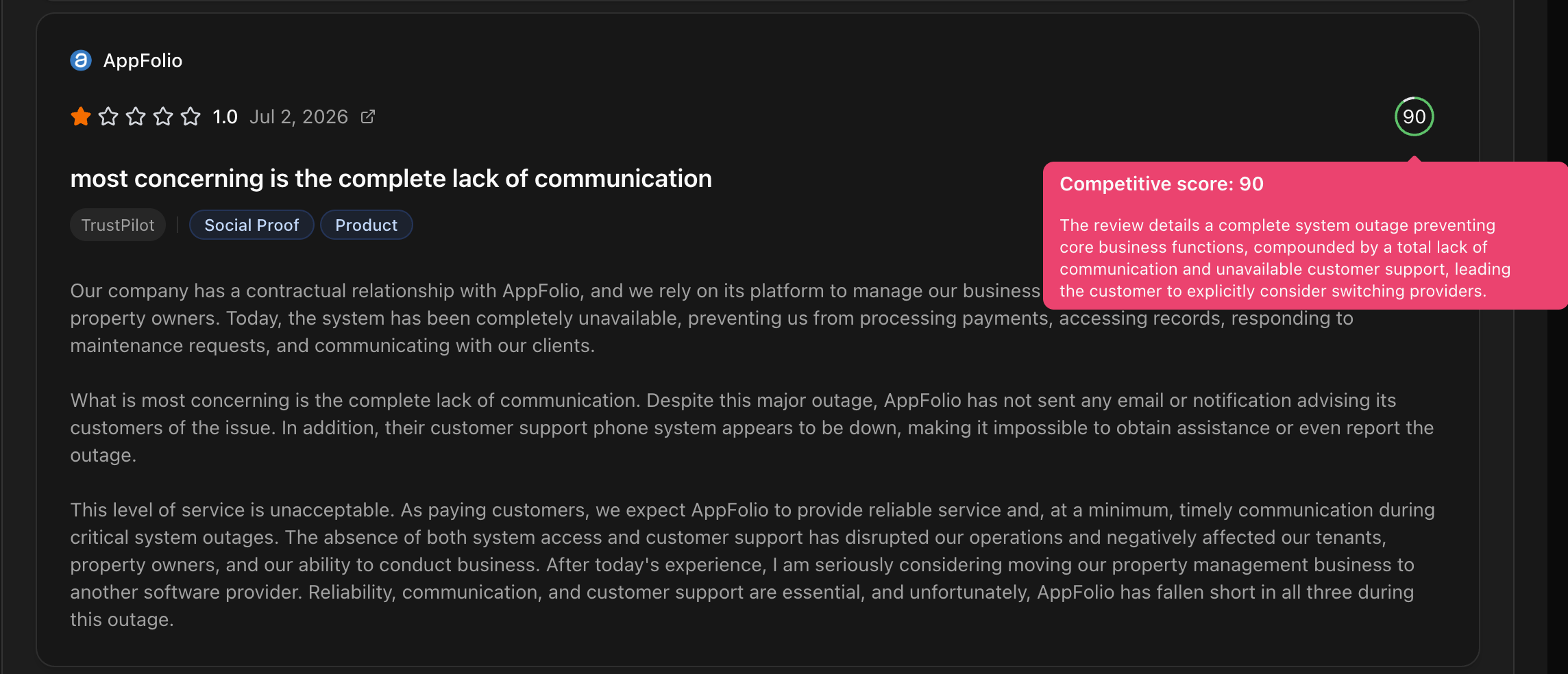
G2, Capterra, TrustRadius, TrustPilot, Software Advice, Yelp and Google Reviews for anything with a physical location or a consumer audience. Reviews are where a competitor's customers tell you what's broken, and they are the single most underused source in CI. Matt Kanakidis at RentBamboo built an entire outbound motion out of this signal: find companies using a competing AI leasing tool, read that tool's negative reviews, and open the cold email with the complaint the prospect is probably living with. The trick is filtering. A competitor with 2,000 reviews has maybe 40 that name a product gap, and you want those 40. Manually: sort each site by lowest rating and most recent, and read weekly.
Competitor review w/ AI scoring rationale in KeepTabz
3. Social media
LinkedIn, X, and organic Facebook, for the company account and for the executives. The exec accounts matter more than people expect. In B2B, a founder's LinkedIn post is usually the first public appearance of a strategy shift, weeks before it hits the website. On the consumer side, a brand's organic Facebook page tends to preview promotions before they go paid. Manually: follow every competitor exec, and accept that the algorithm will bury half of what they post.
4. Website changes
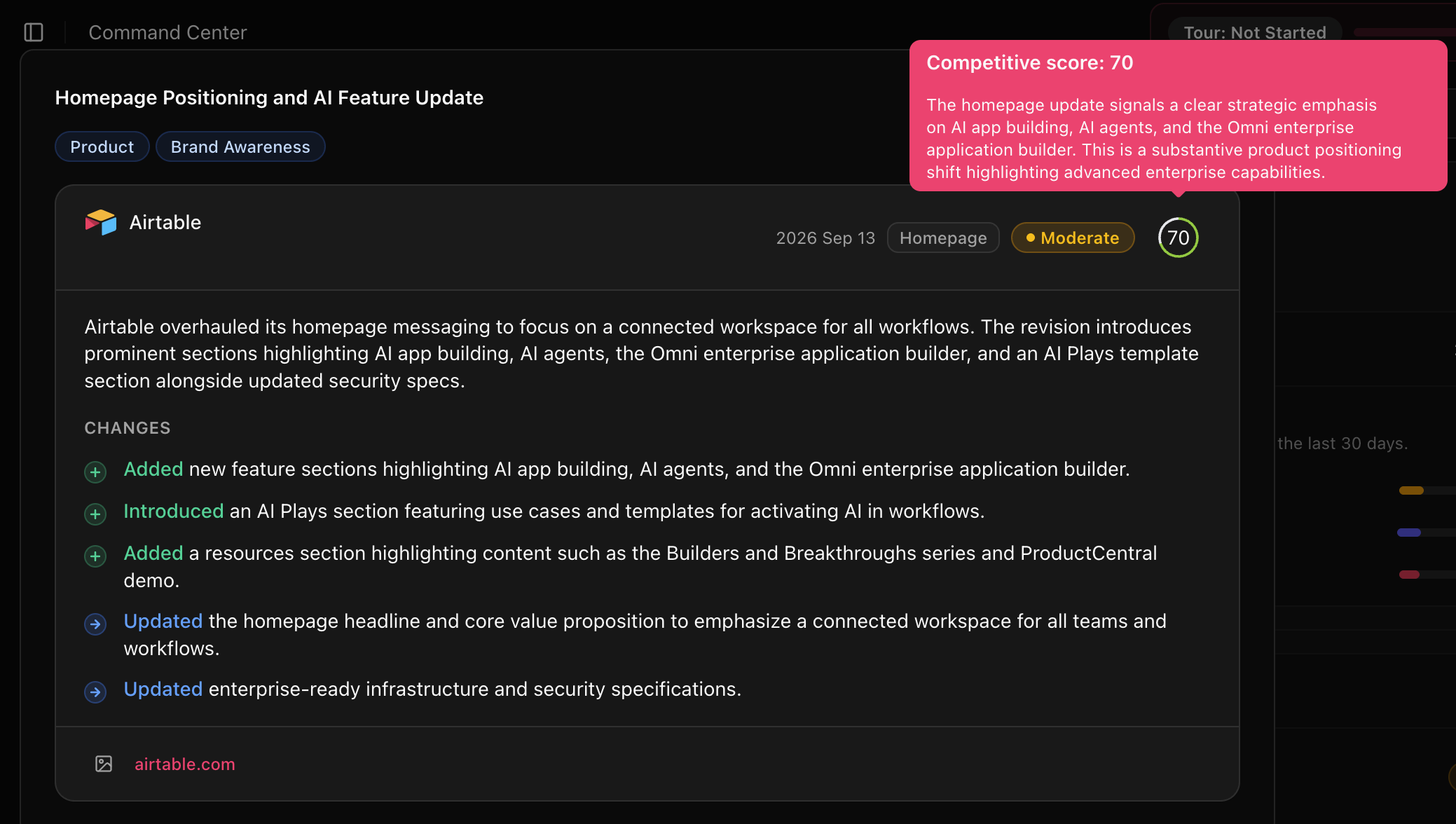
Homepage, product pages, pricing, changelog, docs, careers page, blog, and terms of service. This is the signal I'd pick if I could only have one. Chris Blomquist's team at eSkill caught a top competitor switching their homepage to "AI-native skills" messaging, recognized it as a positioning test, and made a deliberate decision not to chase it. The competitor reverted a few weeks later. Without the diff, eSkill would have either missed it or overreacted to it. The careers page is a leading indicator for new products and new geographies (three sales hires in Germany means Germany). The terms of service page is the sleeper: Zac Brown at GiveKit told me ToS tracking was a signal he didn't know he should be watching until it surfaced a change he cared about, and in our data 39% of tracked software competitors changed their ToS in a single quarter. Manually: a change-detection tool like Visualping on the ten pages that matter most.
Homepage change detected in KeepTabz
5. Ad libraries
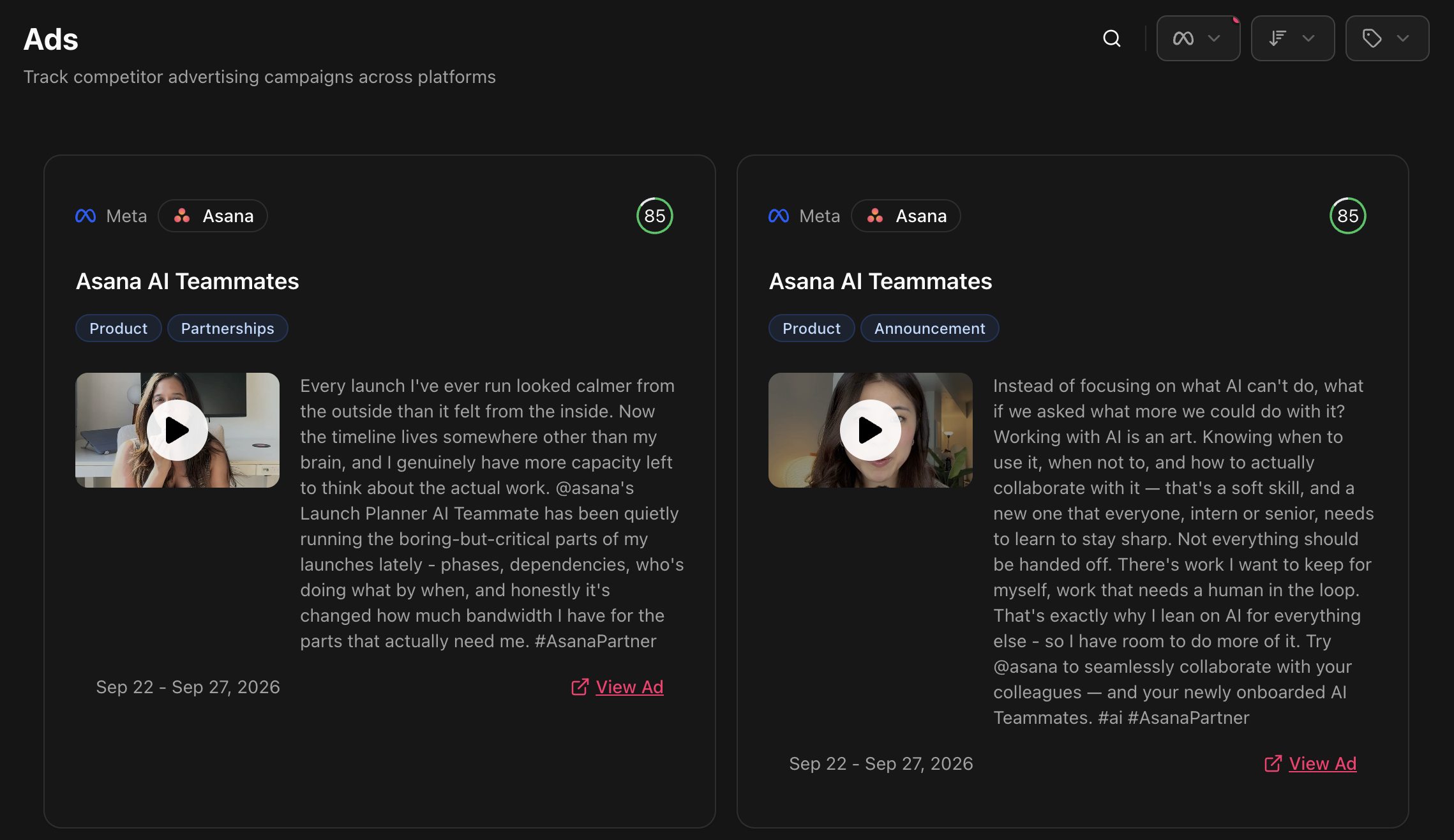
Meta, Google, LinkedIn, and Instagram all publish the ads running on their platforms, and almost nobody looks. The ad library shows you the actual creative, the offer, the CTA and the persona a competitor is spending real money to reach, which is far more honest than their homepage. If a competitor's ads all target "agency owners" and their website says "enterprise," believe the ads. Manually: search each library by advertiser name, monthly, and screenshot what you find, because ads rotate and disappear.
Competitor ads show up as soon as they launch in KeepTabz
6. SEO metrics
Organic traffic, keyword rankings, and which pages earn the clicks. This tells you what a competitor's content strategy actually is, as opposed to what their content calendar says. When we pulled the organic data for our own competitors, Klue's biggest traffic driver wasn't "competitive intelligence"; it was a blog post about Tesla's competitors. That's a strategy you'd never see from the outside. It also surfaces keyword openings: terms a competitor ranks for on page four that you could take with one good article. Manually: Semrush, Ahrefs, or SpyFu on each competitor's domain.
7. PPC metrics
Estimated paid budget, paid clicks, and the keywords a competitor is buying. Paid search is where a competitor votes with their wallet. If their paid keyword list suddenly includes your brand name, you'll want to know that week, not at the quarterly review. If their estimated budget doubles, something changed: new funding, a new leader, or a launch. Manually: the same SEO tools, paid tab.
8. Pricing changes
Public pricing pages, plus packaging, tier names, and usage limits. Same-day detection matters here because sales will hear about it from a prospect by the end of the week regardless, and you'd rather they heard it from you. It also happens more than people think: in the 90 days ending September 2026, half of the software competitors our customers track changed their pricing page at least once, and those that did changed it about six times. Pricing changes tend to leave fingerprints elsewhere first: the terms of service gets updated, the newsletter list gets an offer, the careers page adds a "pricing and packaging" role. Manually: screenshot every competitor pricing page on the first of the month and compare.
9. Messaging changes
Headline, subhead, and category language on the website and in ads. This is a sub-signal of website changes that deserves its own line because it's the earliest visible symptom of repositioning. A competitor that goes from "project management for agencies" to "the operating system for client work" has decided something about who they are selling to, and you'll want to decide whether that helps you or hurts you. The eSkill example above is a messaging change, and the point of the story is that not every change requires a response. Manually: same diffs as website changes, read for words rather than layout.
10. Reddit
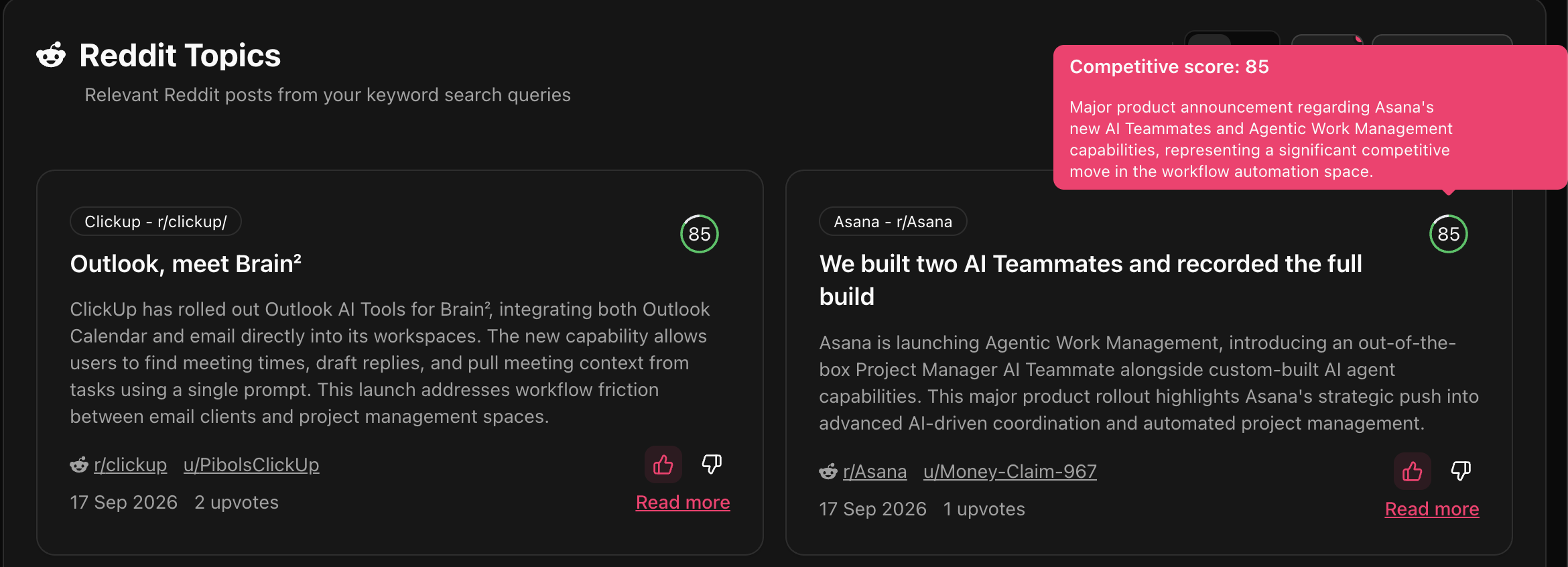
Community mentions across the subreddits where your buyers actually talk. Reddit is the least filtered source on this list. People post what they love and hate about tools with a candor you will never see on G2, and increasingly it's where buyers go to research before they ever hit a vendor website. It's also a source that AI assistants can't read directly, which we'll come back to in section 7. Manually: saved searches for each competitor name across the five to ten subreddits that matter in your category, checked weekly.
Competitor mentions in Reddit threads — read and scored in KeepTabz
11. Market news
News across your whole category, not just the competitors on your list. This is how you spot the competitor you don't have yet: a new entrant getting coverage, a company from an adjacent category moving into yours, a trend that three of your rivals are all suddenly talking about. The competitors you're tracking are the ones you already know about. Market news is for the ones you don't. Manually: a broad category alert, and a tolerance for wading through the noise.
12. Newsletter tracking
Competitor email programs: promotions, launch announcements, and how they segment. Email is the most candid marketing a competitor produces, because it's written for the people most likely to buy and nobody assumes a rival is on the list. The 30%-off offer that never appears on the pricing page shows up here. The launch lands in the newsletter before the blog post. And a win-back email tells you exactly what a churned customer is worth to them. Manually: a burner inbox subscribed to every competitor, which works right up until you forget to check it, which is always.
Reading the signals together
No single signal is decisive. The value is in the overlap: a careers-page change plus a new ad persona plus a repositioned headline is a strategy, and each one alone is a data point. Reading twelve sources by hand across five or six competitors is somewhere around ten hours a week, which is why most small teams do it for a month and then stop. The next section is about how to make it a habit that survives.
5. Who uses competitive intelligence, and for what
At a large company, competitive intelligence has an owner with a title. At a company with 20 or 50 or 200 people, it has whoever cares most, and in my experience that's usually one of four people. Each one wants something different out of it.
Product marketing: positioning and battlecards
This role is somewhat software-industry specific. Competitive intelligence in marketing is mostly about knowing where you can stand that nobody else is standing. The product marketer is the person who reads a competitor's messaging change and decides whether it opens a lane or closes one, who turns a month of ad-library screenshots into "they've moved to selling agencies, we should own in-house teams," and who keeps the battlecards from going stale. In most small companies PMM is the champion for CI and its heaviest user. It's also, in my experience, rarely the budget holder, which matters when you get to section 8.
Sales: talk tracks and objection handling
Sales wants one thing from CI: to never be the last to know. The rep who hears "we're also looking at X" and already has a paragraph on X in their back pocket wins more of those deals than the rep who has to go ask. The Klue revenue-gap data says 47% of reps only learn who they're competing against at negotiation or later; a daily digest fixes that for the cost of reading it. Amanda McGuckin Hager, the CRO at TrueDialog, sends competitor reviews straight to her sales team to share with prospects, which is about as direct as the sales use case gets. Sales ops tends to hold the budget for tools like this, and CROs are the executives who care most, because they own the win-rate number.
Founders and product: roadmap and fundraising
At a startup the CEO is often doing the competitive research personally, usually late at night, usually in a folder of browser tabs. For them CI feeds two decisions: what to build next and what to tell investors. GiveKit redesigned their free tier after spotting a competitor sunsetting a program. Openlane's Kelsey Waters put her read on the competitive landscape into her fundraising deck. Board members increasingly run their own deep research before a meeting, and a founder who can say "here's what all six competitors did last quarter and here's what we did about it" is having a very different conversation than one who can't.
Agencies: client reports and the pitch
Agencies use competitive intelligence in two directions. Inward, as the thing that makes them look smarter than the other agency in the pitch, because they walked in already knowing the prospect's competitors' ad spend and messaging. Outward, as a deliverable: a monthly competitive report for each client that would otherwise take an account manager a day to assemble. Most agencies I talk to still resist charging tech as a line item, so it lands as research time or as part of the retainer, but either way it's billable and the client sees it. Leon Hitchens at Ruskin Consulting runs it this way across his client base.
The pattern
It usually starts in marketing and spreads. The PMM sets it up, sales asks to be on the digest within a month, and then the CEO wants a login because the read on the market is too good to leave to one team. Plan for that from the start: pick a delivery channel the whole company can see, not a marketing-only one.
6. Competitive intelligence examples: six teams, six outcomes
The theory is easier to trust with real cases. These are six KeepTabz customers, and I've picked them because the outcomes are different: one changed a marketing decision, one changed a product decision, one built a sales motion, one ended up in a fundraising deck, one turned it into a service line an agency now charges for, and one is a consumer food brand, not software at all. Three of the six are founder-CEOs doing the tracking themselves, which tells you something about who this work actually falls to at a small company.
Company
Who did the tracking
Before
After
Decision it changed
eSkill
Director of Demand Gen, 5-person marketing team
Manual site checks, listening back to sales calls, weeks-late insight
Daily scan in the morning routine
Chose not to chase a competitor's "AI-native" positioning test
Marketing
GiveKit
Founder-CEO
~2 hrs/day cleaning spreadsheet data
Daily digest; ToS tracking discovered as a signal
Redesigned the free tier after a competitor sunset a program
Product
RentBamboo
Founder-CEO
LinkedIn, G2, news and Google by hand, hours a week
Competitor negative reviews mined for outbound
Built a competitive takeout outbound campaign
Sales
Openlane
Founder-CEO
A folder of Chrome tabs; missed an acquisition by two weeks
Slack digest, reads only high-scoring items
Put the competitive picture in the fundraising deck
Strategy
Ruskin Consulting
COO and co-founder, 50-client agency
Scrapers blocked by Cloudflare, manual deck assembly, reports priced at $300–500 that lost money
MCP server as the source of truth; review and ad reports blended with client ad data
Reports repriced to $1,000–1,500; review management and competitor pages became service lines
Agency revenue
Hess Street Foods
Founder-CEO, consumer food brand
Scrolling competitors' Instagram, TikTok and Facebook by hand, inconsistently
Weekly digest; printed reports run the marketing meeting
Added a promotions program and pivoted growth toward food service and chefs
Strategy
eSkill: a five-person marketing team that stopped guessing
eSkill has been selling pre-employment assessments since 2003, with 4,000-plus customers including FedEx, ADP and Kaiser Permanente, and a marketing team of three full-timers and two contractors. Before: nobody owned competitor tracking. Chris Blomquist, their Director of Demand Generation, was checking competitor websites by hand and listening back through recorded sales calls for competitor mentions, and the insight was usually weeks late. After: a daily scan became part of the morning routine. The payoff came when a top competitor switched their homepage to "AI-native skills" messaging. Chris's team recognized it as a positioning test, decided on purpose to go a different direction rather than spend budget chasing it, and watched the competitor revert a few weeks later. "It's almost like having another team member who proactively tells us what's going on in the landscape of the industry," Chris says. Read the eSkill story.
GiveKit: intelligence that changed the product
GiveKit builds an all-in-one fundraising toolkit for nonprofits, competing against incumbents in the $24 to $50 million ARR range and a wave of new AI-built entrants. Zac Brown, the CEO, was spending about two hours a day cleaning spreadsheet data before he could do anything useful with it. After switching to a daily digest, he got those two hours back, but the bigger outcome was a roadmap call: the intel surfaced a competitor sunsetting a program similar to GiveKit's, and that reshaped GiveKit's new free tier. He also discovered terms-of-service tracking as a signal category he hadn't known to watch. "You can spend a stupid amount of money for a somewhat comparable product, or for just $100 a month, you have access to that kind of enterprise-level competitor intelligence," Zac says. Read the GiveKit story.
RentBamboo: competitor reviews as an outbound engine
RentBamboo makes AI leasing agents for U.S. property management companies; their customers cut lead response times from around 18 hours to about 10 minutes. Matt Kanakidis, the co-founder and CEO, was doing competitor research the way most founders do: LinkedIn, G2, news, Google, hours a week, no single source of truth. The workflow he built after setting up tracking is the most creative use of CI I've seen from a customer. He mines competitors' negative reviews across G2, Capterra, TrustPilot, TrustRadius and Software Advice, finds companies using those competing tools, and opens his cold outreach with the specific complaint the prospect is probably living with. Competitive intelligence became the raw material for a takeout campaign. "It's been a really good creative engine for that," Matt says. Read the RentBamboo story.
Openlane: from a folder of Chrome tabs to a fundraising slide
Openlane is an open-source, AI-native alternative to Vanta and Drata, covering SOC 2, ISO 27001, HIPAA, GDPR, PCI DSS and NIST. Kelsey Waters, the CEO, was tracking competitors with a literal folder of Chrome tabs she refreshed by hand. Prospects were telling her about competitor moves before she'd seen them, and she missed a competitor-on-competitor acquisition by about two weeks. After moving to a Slack-delivered daily digest, she trained herself to ignore the low-scoring items and read only the ones that mattered. Then the intelligence ended up somewhere I didn't expect: in her fundraising deck. "It actually made a compelling part of our pitch as part of our fundraise," Kelsey says. "Now that I really know the value of competitive intelligence, I don't think I could go back." Read the Openlane story.
Ruskin Consulting: competitor monitoring as a service line
Ruskin Consulting is a 50-client marketing agency in Seguin, Texas, running Google, Facebook and LinkedIn ads, landing pages and SEO for auto shops, hydration bars, restaurants and tech startups, plus white-label work for other agencies. Leon Hitchens, the COO and co-founder, had tried selling competitive reports before and lost money on every one: his scrapers kept getting blocked by Cloudflare, the data had to be verified by hand, and the deck took longer to assemble than the $300 to $500 he could charge for it. A review-management upsell failed for the same reason; he couldn't monitor competitor reviews consistently enough to deliver it. Now the agency queries the KeepTabz MCP server from an AI assistant, pulls reviews, ads and website changes for each client's top five competitors, blends that with the client's own Google Ads and Search Console data, and sells the result at $1,000 to $1,500 per report. Review management sells now. Competitor comparison pages, built from what reviewers praise and complain about, became a second service line. "Competitor information is actually worth a lot more than we expected," Leon says. "Almost every single person that has paid for these reports has come away with a lot of information and then also been able to improve their business." Read the Ruskin Consulting story.
Hess Street Foods: a chorizo brand tracking the brands ahead of it
Hess Street Foods makes Abuela's chorizo seasoning, sold at H-E-B, Central Market and Amazon, and it is the example I use when someone tells me competitive intelligence is a software thing. Maria Flores, the founder and CEO, was doing all of it herself: scrolling the Instagram, TikTok and Facebook accounts of Fishwife, Fly By Jing, Siete and Somos between running production, bookkeeping and recipe development, and dropping it whenever something more urgent came up. "When I first saw KeepTabz, I thought KeepTabz was just for SaaS businesses," she told me. "To my surprise, it's exactly what I was doing, but in a faster way, smarter way, more info." She tracks the brands one step ahead of hers, mostly through the ad libraries, website changes, newsletters, organic Facebook and Reddit, gets a weekly digest, and prints the reports to run her marketing meetings, notes in the margins. Two decisions came out of it: she saw the promotions Fishwife and Fly By Jing were running on their sites and realized her brand had no promotions program at all, and she spotted competitors' collaboration tactics and pivoted her growth plan toward food service, restaurants and chefs. She also caught Fishwife's Costco launch, Somos's back-to-school campaign and Siete's Hispanic Heritage Month prep in time to respond, rather than reading about them afterward. "It's a great tool to situate yourself in the industry and understand if you're behind, if you're ahead, if you're right where you should be at." Read the Hess Street Foods story.
The pattern across all four
Every one of these teams started with some version of spreadsheets, browser tabs, and manually scrolling competitors' social accounts. Every one of them names the scoring, the part that separates the three things that matter from the three hundred that don't, as the thing that made it stick. Three of the six, GiveKit, eSkill and Hess Street Foods, ended up changing a product, positioning or growth decision, not just a talking point, and Ruskin turned the intelligence into something clients pay for. That's the outcome to aim for. Competitive intelligence that only ever produces a battlecard is leaving most of its value on the table.
7. Can't I just ask ChatGPT? (And other mistakes)
I get this question in almost every first conversation, and it's a fair one. You can open ChatGPT or Claude, type "give me a competitive analysis of Vanta, Drata and Secureframe," and get back something that looks like a competent analyst wrote it. Two things are wrong with it, and they're worth understanding even if you never buy a tool, because they're the two things any CI process has to solve.
The model has training. It doesn't have your market.
A language model knows a lot about the world in general and very little about what your competitors did last Tuesday. That's a data problem. The places where competitive signal actually lives, ad libraries, LinkedIn, Reddit, G2 and Capterra, news wires, mostly block automated crawlers, and none of them refresh into a model's training data on a schedule you'd want to rely on. So you get a confident summary built from whatever the model absorbed months ago, plus whatever a quick web search surfaced.
A sales leader I know at a fast-growing procurement software company ran a deep-research query on his own competitive set before we talked. Within five weeks of starting at the company he could point to two or three things in that report that were factually wrong about his own competitors. Not out of date. Wrong. And the output was polished enough that you couldn't tell which third without already knowing the answer.
The fix is a context layer: something that goes and gets the data from the sources that block bots, structures it, and puts it in front of the model so it reasons over what's happening rather than what it remembers. That's what our crawlers and data partnerships do, and it's why every marketing workflow on top of it gets better: fewer hallucinated claims in the ad copy, promotions that answer what a competitor is actually offering this week, blog posts aimed at keywords a competitor really ranks for. You can assemble pieces of this yourself with a scraper, a spreadsheet and some patience. Leon Hitchens at Ruskin Consulting tried exactly that for his agency's reports and kept getting blocked by Cloudflare; the data he could get had to be verified by hand, and the reports lost money. He now describes the MCP server as "the source of truth" his AI assistant queries. Most people who try the DIY route stop after a month, because the maintenance is the job.
Finding the insight is half the work. The other half is the deliverable.
The second problem is what happens after the model finds something. A paragraph in a chat window saying "Competitor X appears to be moving upmarket" is a starting point. It isn't a client presentation, a revised battlecard, a set of ad recommendations, or a ranked list of the keywords that will grow fastest if you focus on them for the next 90 days. The gap between collecting intelligence and doing the work that's downstream of it is where most CI efforts die, at big companies and small ones alike. The digest I used to skim at IBM died there too.
The teams getting real value in 2026 have closed that gap by wiring the intelligence into the work: the competitive data feeds an agent that refreshes the battlecard, drafts the monthly client report, or writes the first pass of the content calendar. We built the KeepTabz MCP server for exactly this, so Claude or ChatGPT can query live competitor data and produce the deliverable, not just the observation. Crayon's 2026 survey found 82% of teams running AI agents in their sales motion report a revenue impact, against 42% that don't (Crayon, 2026). I'd read that less as "agents are magic" and more as "the teams who connected intelligence to action are the ones getting paid for it."
Competitive intelligence best practices, and three common mistakes
Google Alerts is a firehose with one source. It covers news, unfiltered, and nothing else. It will not tell you about a pricing change, an ad, a review, or a Reddit thread, and for a competitor with a common name it will bury you in noise. It's better than nothing and I used it for years. It is not competitive intelligence.
The annual competitor deck is stale in 30 days. Given the release velocity in section 2, a point-in-time analysis is out of date before the slides are formatted. Do the analysis, but treat it as a snapshot of a process, not a deliverable in itself.
Sorting by recency instead of impact, and parking it where nobody looks. Chronological feeds guarantee the important item is three screens down under a dozen webinar reminders, and a dashboard your sales team has to remember to visit is one they won't. Whatever your process is, it needs a scoring step and a push.
A note on what's fair game
Everything in this guide comes from public sources: things competitors publish on purpose, or that their customers publish about them. That's competitive intelligence. Pretexting, fake trial signups to get inside a product, paying for leaked documents, or anything you'd be embarrassed to explain to the competitor's CEO at a conference is not, and it isn't necessary. Your competitors are telling you more than enough in public. The work is listening.
8. Competitive intelligence on three budgets: $0, $200 and $60,000
There are really only three ways to run this, and the honest answer about which one is right depends on the size of your team and how much of your pipeline is contested. I've done all three.
$0: DIY
The competitive intelligence tools and techniques here are free and they work, up to a point: Google Alerts for news on each competitor name, a spreadsheet with a row per competitor and a column per signal, a monthly screenshot of every pricing page, saved LinkedIn searches for each competitor's executives, a burner inbox subscribed to their newsletters, the Meta and Google ad libraries checked by hand, a free SEO tool for rankings, and a Friday Slack post summarizing it all. The cost is time, around ten hours a week across five or six competitors, which at a small company is a quarter of a marketer. The failure mode is consistency: everyone I know who has run CI this way, including me, did it well for six weeks and then a launch happened and nobody checked the spreadsheet for two months. If you're pre-revenue or have one competitor, start here anyway. You'll learn which signals matter in your category before you pay for anything.
~$200 a month: A lightweight platform
This is the tier I built KeepTabz for, because it didn't exist when I needed it. For $199.99 a month (less for our Lite plan) you track seven competitors across all twelve signals, the crawl runs daily, an AI agent scores every item for competitive importance, and the top items land in Slack, Teams, Discord or email every morning. Setup takes about 48 hours, most of which is us doing a human QA pass on your data. The MCP server is included on Core and Pro, so you can connect the data to Claude or ChatGPT and build the deliverables from section 7. The Lite plan at $74.99 covers mostly all of this with fewer premium data sources.
Zac Brown at GiveKit put the value this way: "You can spend a stupid amount of money for a somewhat comparable product, or for just $100 a month, you have access to that kind of enterprise-level competitor intelligence." I'll add the honest caveat: this tier is built for teams that value simplicity over depth. If you need dynamic battlecards embedded in Salesforce, a win/loss interview program, or SOC 2 paperwork for procurement, you're in the next tier, at least for now.
$30,000 to $60,000 a year: Enterprise CI
Klue and Crayon are good products, and if you're a Fortune 500 company with a dedicated competitive intelligence team, a two-month implementation budget and a sales enablement platform to plug into, one of them is probably the right call. They go deeper on battlecard workflows, win/loss programs and CRM integration than anything at the $100 tier does, and they have the compliance credentials enterprise procurement will ask for. The trade is price and weight. The quotes I've heard from our customers are in the $60K a year range, and the implementation timeline was sometimes months. For a marketing team of five, that's not a tool, it's a headcount.
Side by side
Do it yourself
Lightweight platform (KeepTabz Core)
Enterprise CI (Klue, Crayon)
Cost
$0 plus ~10 hrs/week
$199.99/month
~$30–60K/year
Setup
An afternoon, then ongoing upkeep
48 hours, done for you
4–8 weeks
Sources
Whatever you check by hand
12 signals, crawled daily
Broad, with CRM and enablement integrations
Scoring
You, when you have time
AI-scored, with rationale
Analyst-curated plus AI
Delivery
A Slack post when someone remembers
Daily digest to Slack, Teams, Discord, email
Battlecards in CRM and enablement tools
AI / agent access
Manual copy-paste
MCP server (Core and Pro)
Varies by vendor
Right for
Solo founders, one competitor, pre-revenue
Teams of 2–50 in crowded categories, agencies
Enterprise CI teams with a program to run
Pick the row that matches the team you have this quarter, not the one you plan to have in three years. Moving up a tier later is easy. Paying for a tier you can't staff is how CI tools become shelfware, and I've watched that happen at every budget level.
9. Get started: the 10-minute-a-day competitive intelligence checklist
You can set this up in an afternoon. Here's the template I'd use, whether or not you ever pay for a tool. (Download it as a one-page PDF here.)
Pick 3 to 7 competitors: one bigger than you, one your size, one that didn't exist two years ago
Choose the signals that matter in your category from the twelve in section 4 (B2B: reviews, exec LinkedIn, pricing, website changes; B2C: Google Reviews, organic Facebook, Meta ads, Reddit)
Write down the four decisions CI feeds at your company and who owns each: pricing, positioning, roadmap, sales talk tracks
Decide where the intelligence gets delivered, and make it a channel the whole company can see
Set a daily 10-minute slot for one person to read and route what came in
Screenshot every competitor pricing page today, so you have a baseline
Subscribe to every competitor newsletter (from an inbox you'll actually check, or a tool that does it for you)
Put a 30-day reminder on the calendar to ask one question: which decision did this change?
If you'd rather skip the spreadsheet, start a free 14-day KeepTabz trial. You'll have all twelve signals on your competitors in your Slack within 48 hours. Or book 20 minutes with me and I'll walk you through what your competitive set looks like; I still do every demo personally.
Frequently asked questions
What is the difference between competitive intelligence and competitive analysis?
Competitive analysis is a point-in-time comparison of competitors on a fixed set of criteria, usually delivered as a deck or a matrix. Competitive intelligence is the continuous practice of tracking what competitors are doing and acting on it. Analysis is a snapshot; intelligence is the feed that keeps the snapshot current.
Is competitive intelligence legal?
Yes, when it uses public sources: competitor websites, press, social media, review sites, ad libraries, newsletters and public filings. It becomes a problem when it involves misrepresentation, unauthorized access, or paying for confidential information. Everything in this guide is based on what competitors and their customers publish openly.
How often should you do competitive intelligence?
Daily, in small doses. Crayon's 2026 data shows teams that share intelligence weekly or faster report a revenue impact 79% of the time, versus 41% for teams on a monthly or slower cadence. A ten-minute daily read beats a quarterly deep dive that's out of date by the time it's presented.
What are the main sources of competitive intelligence?
Twelve signals cover most of it: news and PR, review sites, social media (company and executive accounts), website changes, ad libraries, SEO metrics, PPC metrics, pricing changes, messaging changes, Reddit, whole-market news, and competitor newsletters. Which ones matter most depends on whether you sell to businesses or consumers.
Can ChatGPT do competitive intelligence?
Partly. A language model reasons well about competitive data, but it can't collect it on its own: the sources with the most signal (LinkedIn, Reddit, review sites, ad libraries) block automated crawlers, and training data is months old. You can feed it data you gathered by hand, or connect it to a live competitive data layer. Either way, the model needs current data underneath it to produce anything you'd act on.
How much does competitive intelligence software cost?
From free (Google Alerts and a spreadsheet) to roughly $30,000 to $60,000 a year for enterprise platforms like Klue and Crayon. Lightweight platforms built for smaller teams, including KeepTabz, start at $75 bucks a month. The right tier depends on team size and how much of your pipeline is contested.
Who should own competitive intelligence at a small company?
Whoever will actually read it every day. In practice that's usually product marketing or the founder, with sales as the first internal customer. What matters more than the owner is the delivery channel: pick one the whole company can see, because sales and the CEO will want in within a month.




.png)