May 23, 2026

30
min read
10 Best Competitive Intelligence Tools & Software 2026
We tested and analyzed the 10 best competitive intelligence software platforms of 2026. See how KeepTabz, Crayon, Klue, Kompyte and 6 others compare.


We tested and analyzed the 10 best competitive intelligence software platforms of 2026. See how KeepTabz, Crayon, Klue, Kompyte and 6 others compare.

We evaluated the ten leading competitive intelligence platforms of 2026 on pricing, signal coverage, AI scoring, and time-to-value. The market splits into three groups. KeepTabz leads on signal breadth and accessible pricing, covering nine competitive signal types in a single AI-scored daily digest starting at $59.99 per month. Enterprise platforms like Crayon, Klue, Kompyte, and Contify start in the mid-five figures and target large competitive intelligence teams. Single-signal tools like Owler, Visualping, and Similarweb cover narrower slices for a lower entry price.
84% of B2B leaders say their market got more competitive in the last three years. Two-thirds of deals are now competitive, and the average company is losing roughly a third of its revenue to direct competitors. Almost none of the affected teams can name what their top three competitors shipped, priced, or messaged last week.
Most teams patch the gap with Google Alerts, a shared Notion doc, and a folder of Chrome tabs nobody refreshes. That works until a competitor announces a customer win in your top account, or quietly drops their entry price by 30%. Then it stops working.
We evaluated the ten best competitive intelligence software platforms of 2026, including KeepTabz, Crayon, Klue, Kompyte, and six others. The comparison below covers pricing, signal coverage, AI capabilities, and the use case each one actually fits.
KeepTabz powers competitive intelligence for B2B software companies across SaaS, GRC, PropTech, and developer tools. We talk to prospects every week who are evaluating, switching from, or stacking us alongside the tools in this guide. The recommendations below reflect what we've seen inside real sales workflows, not what the vendors say on their marketing pages.

Competitive intelligence software tracks what competitors are doing across the channels that matter (news, reviews, social posts, ads, website changes, pricing pages, SEO results, and paid search), and turns the raw activity into a feed that go-to-market teams can actually use. Where Google Alerts gives you a stream of unfiltered news, modern competitive intelligence software adds AI scoring, daily digests, and structured access to the third-party data sources (LinkedIn, G2, ad libraries) that large language models cannot crawl directly.
The category sits at the intersection of marketing analytics, sales enablement, and product strategy. A well-implemented competitive intelligence platform replaces the work of an in-house analyst, surfaces moves before they show up in win-loss reports, and feeds clean competitive data into the AI agents teams are now building on top of their own stacks.
Best for: B2B teams that want enterprise-grade competitive intelligence at pricing that does not require a board meeting to approve.
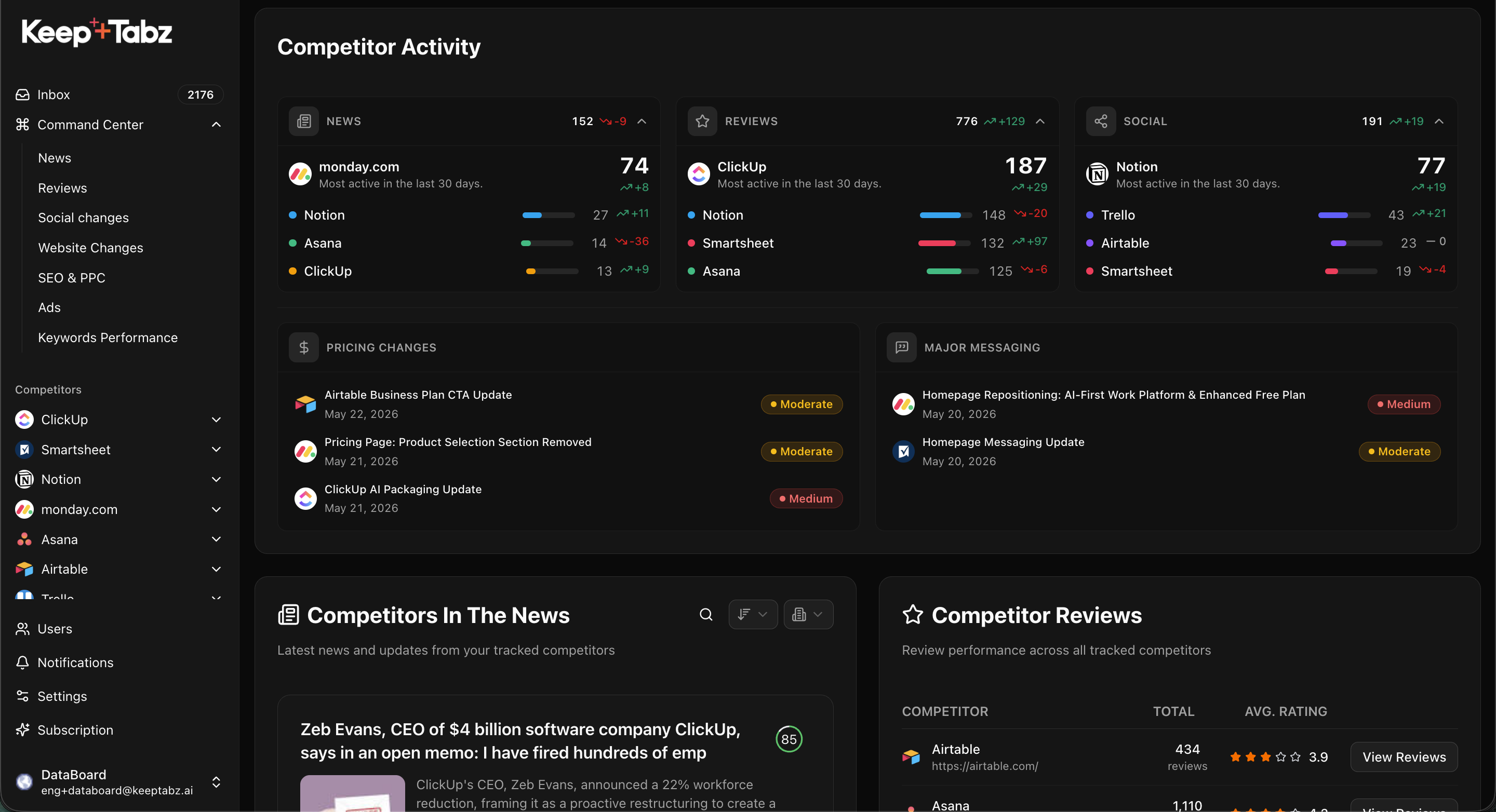
KeepTabz is the only competitive intelligence platform that watches nine signal types and scores every update with a CI-trained AI agent, delivered to Slack as a daily digest, at roughly 1/50th of the price of Klue or Crayon. We built KeepTabz because the old answer to "what are our competitors doing?" was either a $60,000-a-year enterprise contract or a folder of Chrome tabs, and the gap between those two options is where most B2B teams have been quietly losing deals.
Disclosure: KeepTabz is our platform. We've aimed to give a fair, evidence-based evaluation of how it compares to the alternatives in this guide.
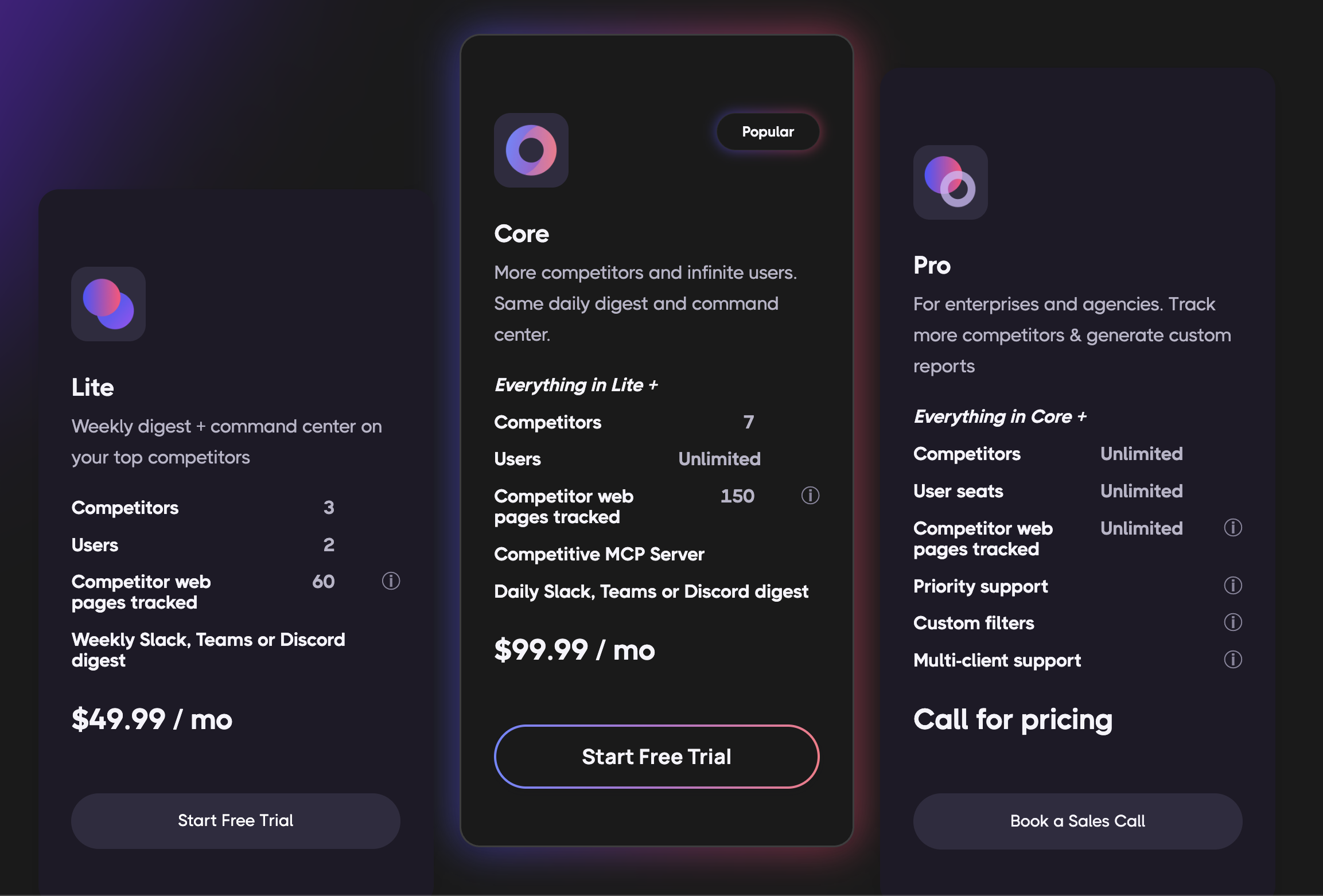
KeepTabz offers a free 14-day trial on every plan. Paid pricing:
Every plan includes account setup within 48 hours and a human QA check on the data.
"Now that I really know the value of competitive intelligence, I don't think I could go back," says Kelsey Waters, CEO of Openlane, an open-source alternative to Vanta and Drata. Waters credits the daily digest with replacing a folder of Chrome tabs she used to refresh by hand, and the competitive picture KeepTabz delivered ended up in Openlane's fundraising deck.
Best for: Enterprise revenue teams that need battlecards delivered into Salesforce, Slack, and Highspot.
Similar to: Klue.

Crayon was one of the first dedicated competitive intelligence platforms for B2B and remains a category leader for enterprise teams. The product is built around three areas: tracking competitor activity, building battlecards that live inside seller tools, and analyzing win-loss data. Crayon is strongest when a dedicated competitive intelligence or product marketing team owns the program and pushes content into sales workflows on a regular cadence.
Crayon does not publish list pricing. Third-party procurement data places contracts in the $20K to $40K-plus per year range, with most starting around $25K. Pricing scales with the number of competitors tracked, feature tier (Essentials, Professional, Enterprise), and contract length. Add-ons like custom integrations and professional services can add 15 to 30 percent to base costs. For a deeper breakdown, see our Crayon alternatives guide.
Best for: Large competitive intelligence and product marketing teams running formal win-loss programs.
Similar to: Crayon.

Klue is the other major enterprise competitive intelligence platform alongside Crayon. The pitch is "competitive intel and win-loss from one platform," and the product is built for large product marketing and revenue enablement teams that publish regular intel newsletters, manage dozens of battlecards, and want a structured workflow for collecting win-loss interviews. Klue has invested heavily in AI-generated insights and intel summaries over the past two years.
Klue does not publish list pricing. Procurement data suggests contracts typically start around $16,000 per year and scale past $40,000 depending on user count and feature tier (Essentials, Professional, Enterprise). Per-user pricing decreases with volume, and add-ons like premium support and custom integrations are priced separately. See our Klue alternatives guide for the full breakdown.
Best for: Marketing teams already running on Semrush who want a competitive intelligence layer inside that stack.
Similar to: Crayon and Klue, positioned downmarket.

Kompyte was an independent competitive intelligence platform until Semrush acquired it. The product is now a marketing-first CI tool that lives alongside Semrush's SEO and digital marketing suite, and it tends to be the cheaper option among the enterprise CI platforms. Kompyte is strongest when competitive intelligence is being run as an extension of an existing marketing workflow rather than a standalone program.
Kompyte does not publish pricing. Third-party sources cite contracts starting around $20,000 per year, often bundled with Semrush Enterprise. Some sources reference three plans (Essentials, Professional, Unlimited) starting at $300/month, though that pricing is not published on Kompyte's own site. Bundling with an existing Semrush contract lowers the effective cost.
Best for: Digital marketing teams that care most about competitor web traffic, audience overlap, and digital share of voice.
Similar to: Semrush, Ahrefs.
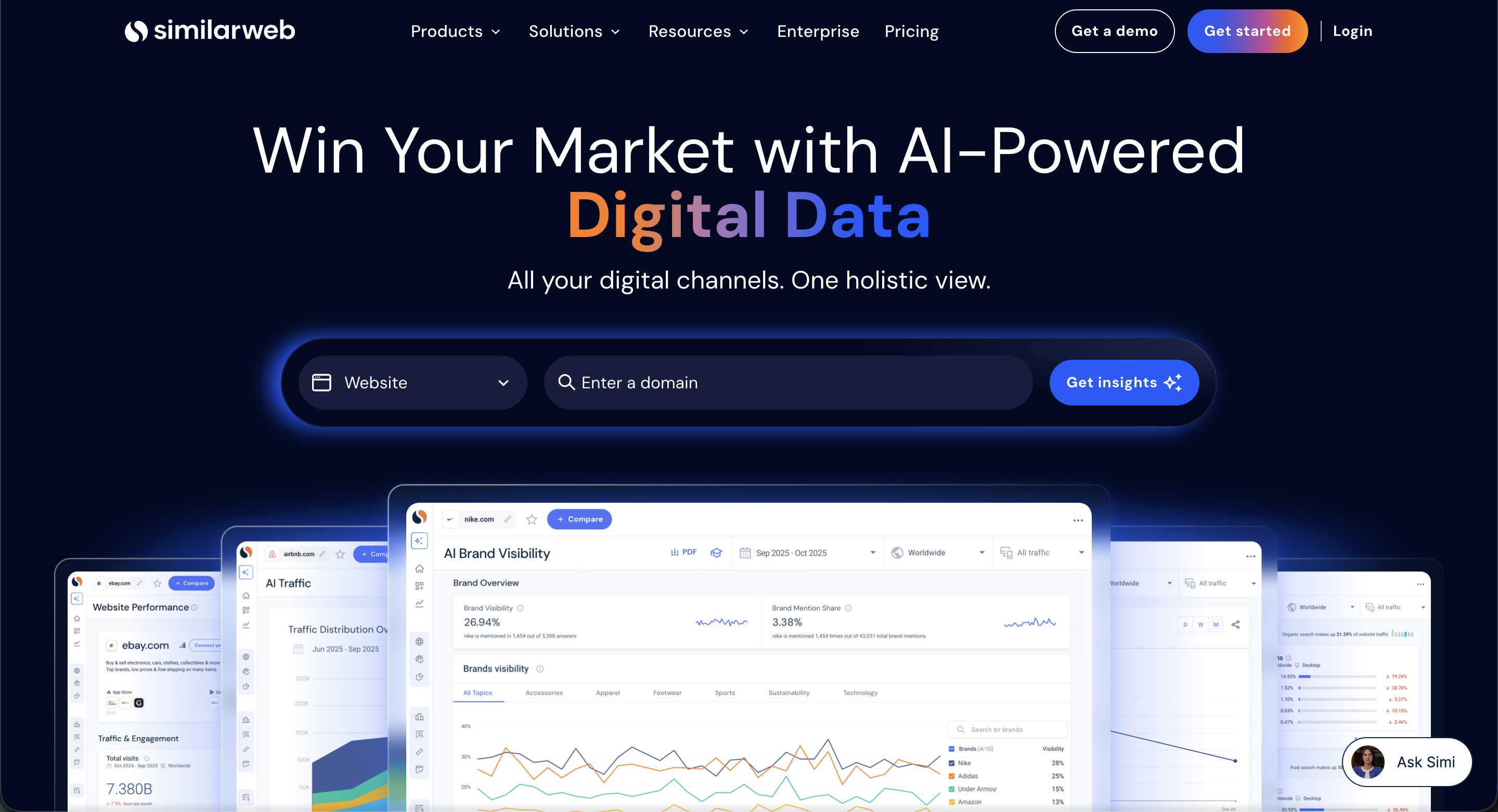
Similarweb is the dominant digital intelligence platform for measuring competitor website traffic, audience overlap, and digital share. It covers more than a billion websites and millions of apps across 190 countries. Competitive intelligence is one of several use cases for the platform (it also serves investor research, marketing strategy, and sales prospecting), and the depth of digital analytics is hard to match in any tool that bundles traffic data with broader CI signals.
Similarweb publishes tiered pricing. The Starter plan begins at $149/month ($1,500/year on annual billing). Professional is $333/month. Sales Intelligence starts at $129/month for individuals, with Business and Enterprise tiers beginning around $16,000/year. Monthly billing adds a 20 to 25 percent premium over annual.
Best for: Small teams that mostly need company news, funding announcements, and basic competitor profiles.
Similar to: Crunchbase News (lighter), CB Insights (less analytical).

Owler is a company news and intelligence platform with a free community tier and an affordable Pro plan, which makes it one of the more accessible options on the market. The product is built around company profiles: revenue estimates, funding, acquisitions, employee headcount, and a news feed per competitor. Owler is at its best when the main thing a team needs is a steady stream of company news and funding alerts.
Owler offers a free community tier with basic profiles. Pro is $39/user/month billed annually ($468/user/year), with some sources citing $35/month depending on promotional periods. Enterprise pricing is custom. The free tier is genuinely usable for light competitor tracking.
Best for: Anyone who needs to be alerted the moment a specific competitor page changes.
Similar to: Distill.io, ChangeTower.

Visualping is the category leader for single-purpose website change monitoring. The product watches specified URLs, takes regular snapshots, and alerts users when the page changes (visually, in HTML, or based on plain-language conditions like "tell me if the pricing page mentions $99"). It is used by more than two million people and roughly 80 percent of the Fortune 500. Visualping isn't a full competitive intelligence platform, but it is the right tool when the use case is narrow.
Visualping has a free tier. Personal plans start around $14/month. Business plans start at $100/month. Pricing scales with total page checks per month, number of pages monitored, and check frequency.
Best for: Enterprise competitive and market intelligence analysts pulling from millions of structured sources.
Similar to: Klue and Crayon, positioned for analyst teams.
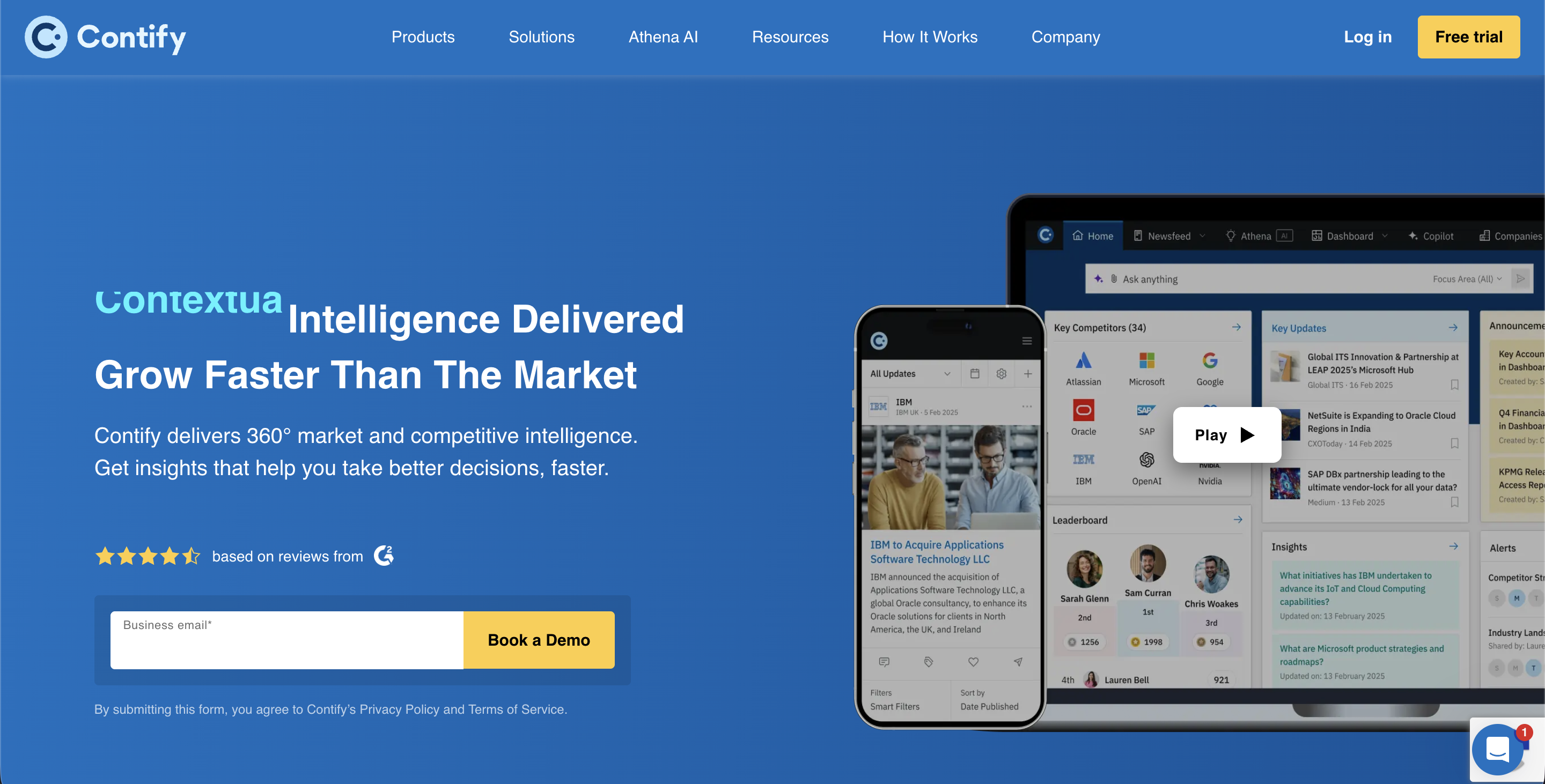
Contify is an AI-native market and competitive intelligence platform aimed at enterprise CI and corporate strategy teams. It was named a Visionary in the 2026 Gartner Magic Quadrant for Competitive and Market Intelligence Platforms. The product covers more than a million vetted sources across 117 languages, which makes it strong for global enterprises with multilingual competitor sets.
Contify uses custom pricing only, based on data volume, feature tier, user count, and integration needs. There is no published tiered pricing or self-service plan. Expect enterprise contract sizes consistent with the analyst-grade positioning.
Best for: SEO and digital marketing teams that want competitive search and traffic data inside Semrush.
Similar to: Similarweb, positioned as a Semrush add-on.
Semrush .Trends is an add-on to Semrush's main SEO platform that layers competitive traffic analytics and market intelligence on top of the existing toolkit. It is the right answer when the team is already paying for Semrush and just needs competitor traffic, search, and paid intel layered on top of SEO workflows. .Trends is not a standalone competitive intelligence platform; it is a competitive layer for an SEO toolkit.
.Trends is $289/month as an add-on, on top of a base Semrush subscription (Pro at $139.95/month, Guru at $249.95/month, or Business at $499.95/month). All-in, expect $429 to $789/month for an SEO base plan plus .Trends. Additional user seats are $45 to $100/month each.
Best for: Investment research, consulting, and corporate strategy teams analyzing dense documents and filings.
Similar to: Bloomberg Terminal (lower-cost adjacent), CB Insights.
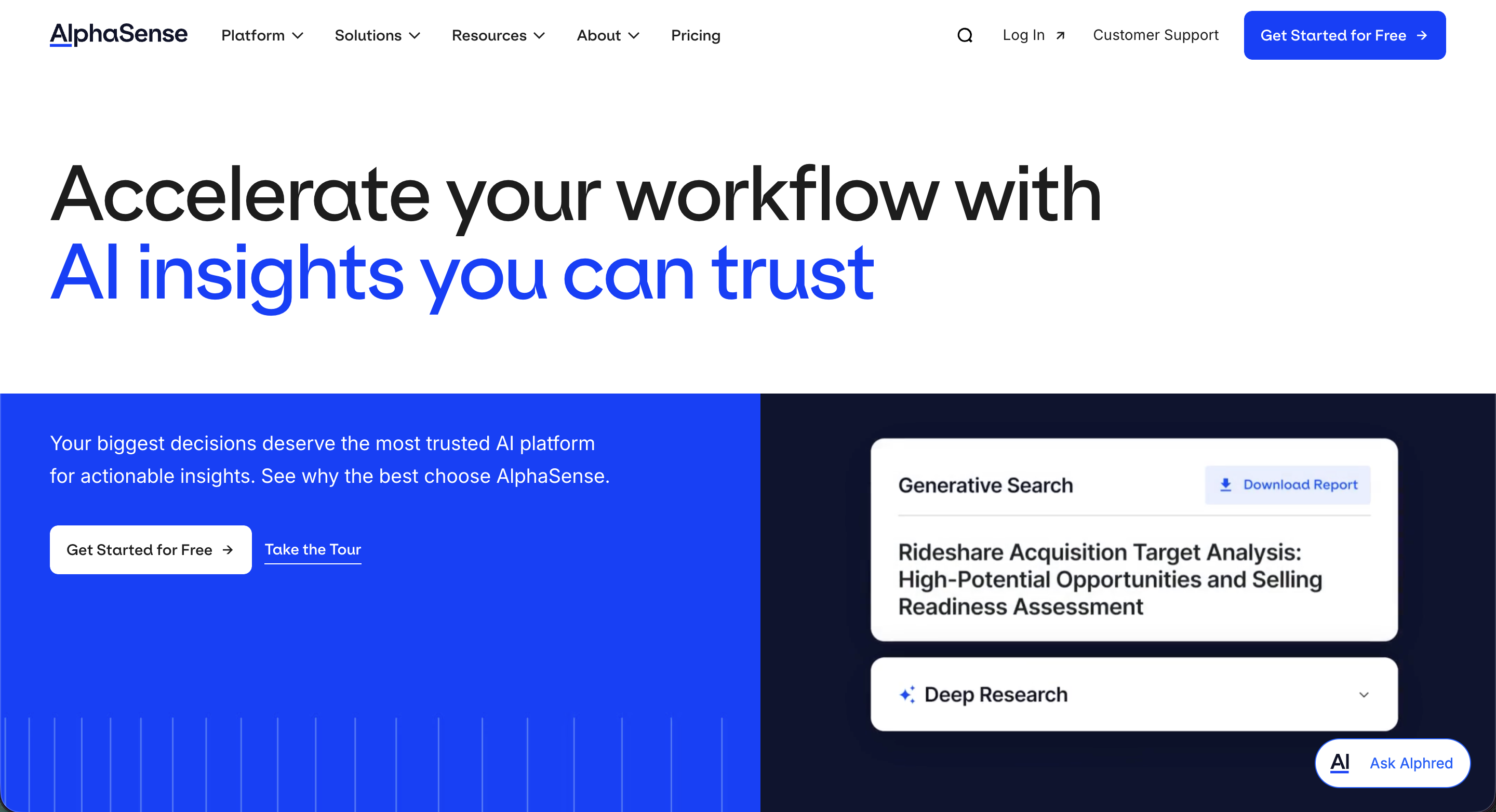
AlphaSense is the market intelligence and document search platform of choice for investment, consulting, and corporate research teams. The product was named a Leader in the 2026 Gartner Magic Quadrant for Competitive and Market Intelligence Platforms, positioned highest on Ability to Execute. AlphaSense added Generative Search and Workflow Agents in early 2026, evolving the platform from a search engine into an end-to-end research tool that can build market landscapes, primers, SWOT analyses, and slide decks.
AlphaSense starts at $10,650/year and scales based on user count and source access. Pricing is customized for small and mid-sized companies. Multi-year contracts and seat volume reduce the effective per-seat cost.
Decide what you actually need the platform to do. Are you arming sales for competitive deals? Catching pricing and messaging shifts? Feeding an AI agent? The right tool for a 40-person PMM team running a formal win-loss program is not the right tool for a five-person marketing team that just wants to stop being blindsided. Write down the one thing the tool has to do, then evaluate against that before anything else.
Competitive intelligence platforms vary widely on signal coverage. Some are news-only. Some are traffic-only. Some cover nine signal types in a single feed. Make a list of where your competitors are actually moving (LinkedIn posts, G2 reviews, ad creative, pricing pages, hiring pages, the changelog), and only consider tools that watch those signals natively. If you have to stitch three tools together to cover the basics, the answer is one tool that covers them all.
A daily firehose of un-scored competitor activity is just Google Alerts with a paint job. Ask any vendor how their AI scores competitive importance, and ask to see the rationale on individual items. If the tool cannot show you why something was flagged as a 90 versus a 40, the scoring is either shallow or absent. Transparent scoring is what makes a daily digest worth opening.
Slack, Microsoft Teams, Discord, Salesforce, HubSpot, and (increasingly) Claude or ChatGPT via MCP are where work happens. A CI tool that needs you to log into yet another dashboard is going to lose to one that drops the right intel into a channel you already check. Confirm the integrations you need before you start a trial, not after.
Custom pricing usually means "more than you want to pay." Enterprise CI platforms like Crayon, Klue, and Contify start in the mid-five figures per year, and the implementation runs eight weeks or more. Tools with public pricing (KeepTabz, Similarweb, Owler, Visualping) cost less and ship in days, sometimes hours. If your team has not run a CI program before, start with a transparent-priced platform that delivers value in week one and graduate to the heavier platforms only when there's a concrete reason to.
Every week, a competitor publishes a customer win, drops their entry price, or rewrites their home page to claim your differentiator. The teams who hear about it on the same day make adjustments. The teams who hear about it from a lost deal three weeks later just lose.
The right competitive intelligence software is not the one with the longest feature list. It is the one that gets the signal into the hands of the people who can do something about it, before the market moves again. For enterprise CI teams with budget and dedicated headcount, Crayon and Klue are credible answers. For everyone else (and that is most B2B SaaS teams), the answer is KeepTabz: nine signal types, AI scoring, a daily Slack digest, an MCP server for your AI agents, and pricing that does not require procurement.
Start your free 14-day trial at keeptabz.ai/pricing, or book a demo and we'll show you what your competitors are doing this week.
Competitive intelligence software shows go-to-market teams what competitors are doing across news, reviews, social posts, ads, website changes, pricing, and SEO. Teams use it to prioritize the right deals, prep sales for competitive conversations, catch pricing and messaging shifts before customers notice them, and feed structured competitor data into AI agents. Modern platforms like KeepTabz score every update for competitive importance and push the highest-impact moves into Slack each day.
SEO tools like Semrush and Similarweb cover competitor search, traffic, and paid intelligence. Competitive intelligence platforms cover those signals plus news, reviews, social posts, ad creative, website and pricing changes, and messaging shifts in a single feed. Some teams stack both. KeepTabz bundles all nine signal types and adds AI scoring so users do not need to stitch three or four point tools together.
Yes. Most modern competitive intelligence platforms integrate with Slack, Microsoft Teams, Discord, Salesforce, and HubSpot. KeepTabz delivers a daily digest to Slack, Teams, Discord, or email, and exposes all of its data through an MCP server that connects to Claude, ChatGPT, Zapier, Make, and n8n. Enterprise platforms like Crayon and Klue add battlecard delivery into Salesforce and Highspot.
There are free tiers from Owler (basic company profiles and news) and Visualping (limited website change monitoring), and Google Alerts is free but covers only news and is very noisy. Most full-featured competitive intelligence platforms charge a subscription. KeepTabz offers a free 14-day trial on every plan, with paid plans starting at $59.99/month.
For SMB and mid-market teams, KeepTabz is generally the best ROI in the category. Pricing starts at $59.99/month, the platform covers nine signal types, and AI scoring removes the noise that buries Google Alerts. Crayon, Klue, and Contify are built for enterprise CI teams and tend to cost $20K to $40K-plus per year, which is hard to justify for teams under roughly $50M in revenue.