May 15, 2026

30
min read
10 Best Klue Alternatives & Competitors [2026]
A breakdown of the strongest Klue alternatives in 2026, including full-suite competitive intelligence platforms, specialized tracking tools, and free or DIY options.
![10 Best Klue Alternatives & Competitors [2026]](https://cdn.prod.website-files.com/68100b769b154c0a404922e6/690fc0df354fc80ec6e11624_headshot1.png)

A breakdown of the strongest Klue alternatives in 2026, including full-suite competitive intelligence platforms, specialized tracking tools, and free or DIY options.
![10 Best Klue Alternatives & Competitors [2026]](https://cdn.prod.website-files.com/68100b769b154c0a404922e6/6a0f804d5b6f16ed83b07938_KeepTabz%20Promo%20(5).png)
TL;DR
The strongest alternatives to Klue in 2026 are KeepTabz, Crayon, Kompyte, Contify, Visualping, AlphaSense, Brand24, Google Alerts, and AI deep-research tools (Perplexity / ChatGPT Deep Research). They split into three groups — full-suite platforms that replace Klue head-on, specialized tools that handle one specific slice of what Klue does, and free or DIY options for teams with no tooling budget. The right choice depends entirely on which slice of Klue's product suite you actually need to replace.
There are plenty of solutions that track one specific competitor activity channel, like SEO or social. But if you’re looking for a more complete competitive intelligence
If you're looking to replace the full Klue product surface — battlecards, win/loss, competitive newsfeed, Salesforce-embedded deal tips — these are the four most credible swaps. KeepTabz is our pick of the four, and we'll explain why honestly enough that you can decide for yourself.
Best for: B2B SaaS marketing, product marketing, sales, and CRO teams that need enterprise-grade competitive intelligence without an enterprise CI budget or two-month implementation.
Similar to: Klue, Crayon, Kompyte, Contify.
KeepTabz is an AI-powered competitive intelligence platform built for the 95% of teams who can't afford Klue, Crayon, or Contify but need more than Google Alerts and basic AI. It tracks every move your competitors make — news, reviews, social posts, website changes, pricing shifts, ad campaigns, SEO and PPC performance — scores each update for competitive importance, and delivers the highest-impact items as a daily digest in Slack, Microsoft Teams, Discord, or email. Setup takes 48 hours with a human QA check on every account.
Heads up: KeepTabz is our platform. The goal of this section is an honest comparison, not a one-sided pitch. If a different tool below fits your situation better, that's the one we'd point you to.
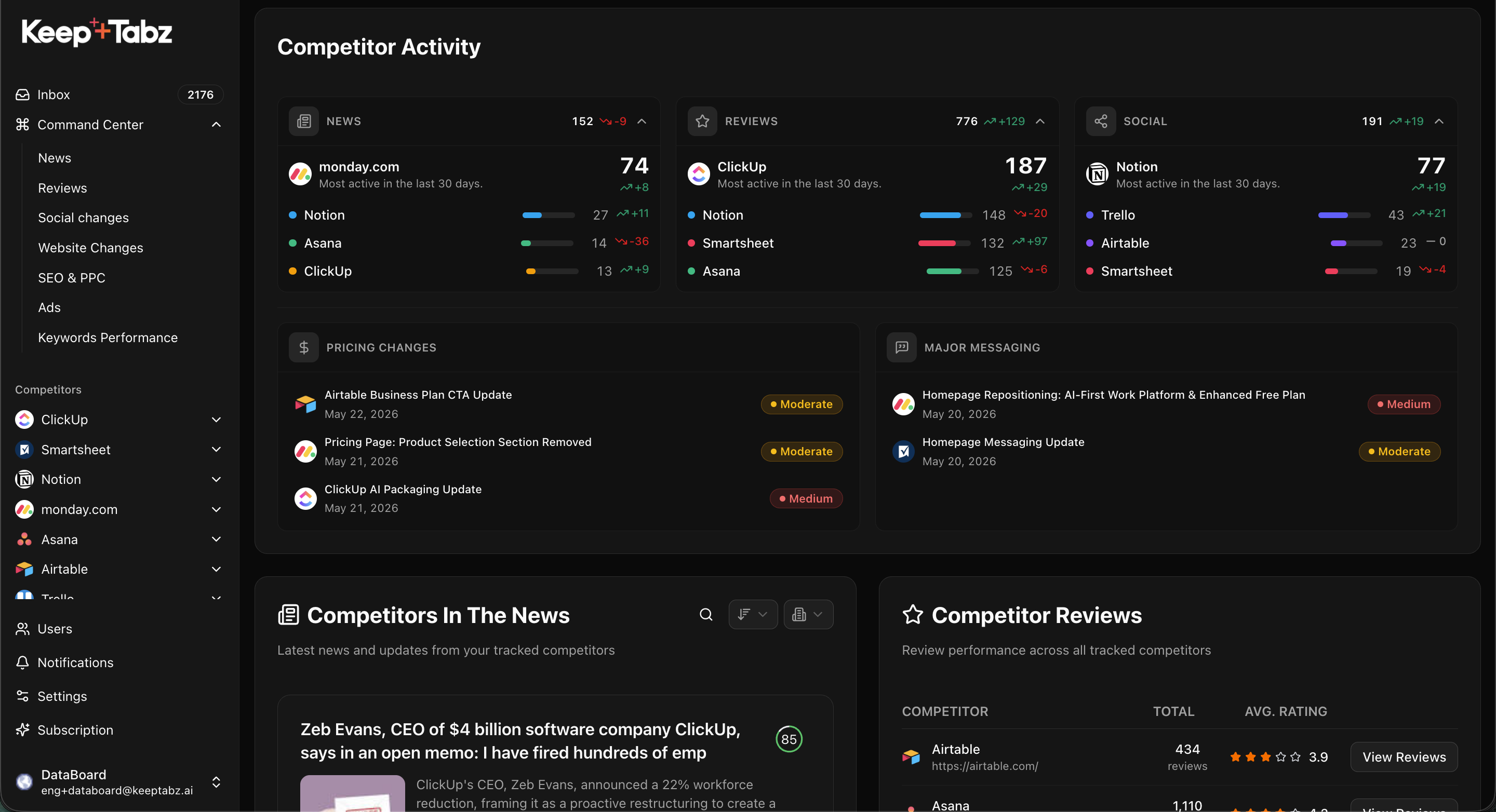
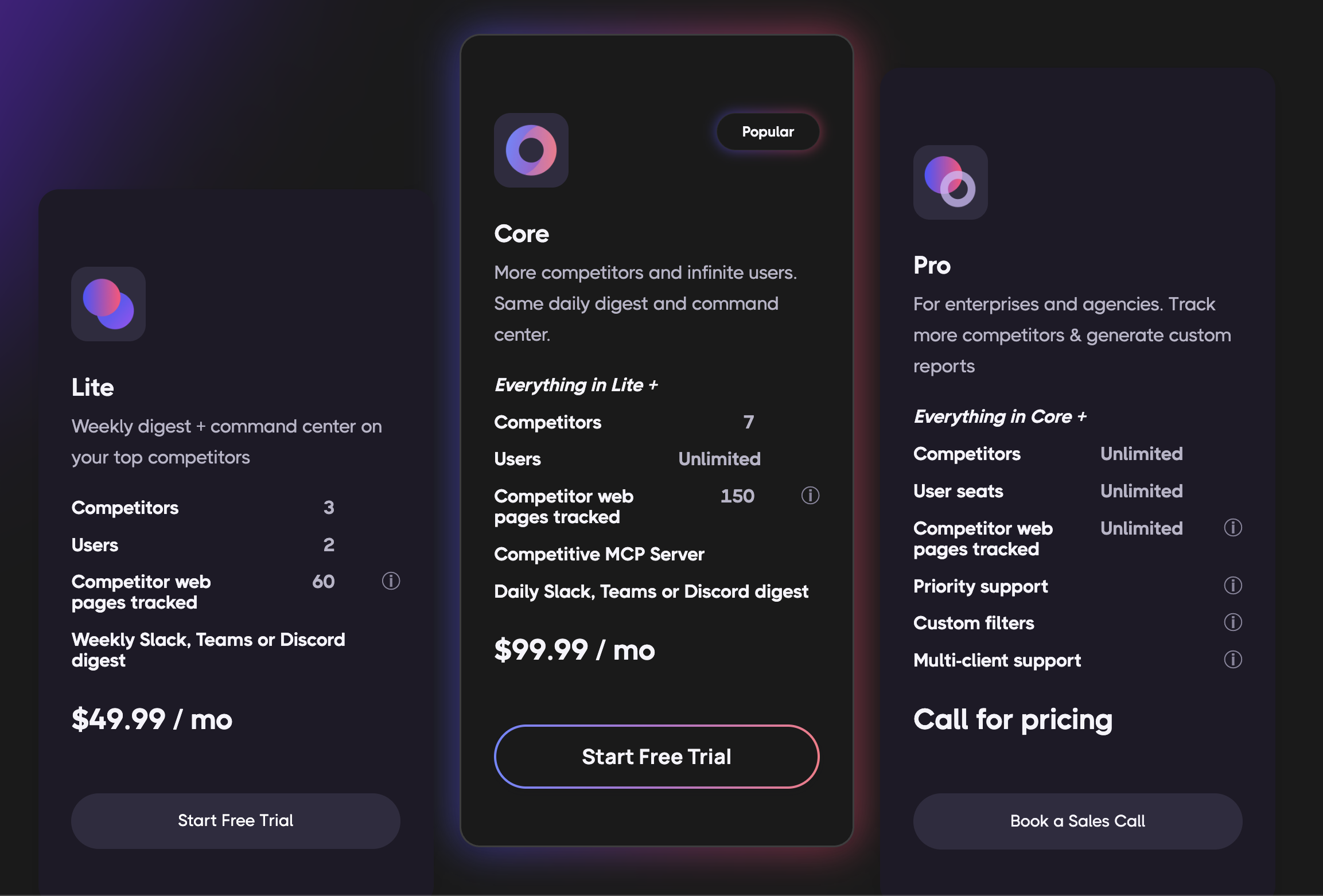
The original case for building KeepTabz was that Klue and Crayon — the two dominant CI platforms — cost roughly $50,000 a year and require long implementations. That puts real competitive intelligence out of reach for almost every company under 1,000 employees, exactly the segment where competitive pressure has accelerated fastest in the AI era. KeepTabz delivers the same source coverage and the same AI-driven scoring at $49.99/mo for Lite and $99.99/mo for Core, with no implementation fee, no required onboarding services, and a working dashboard inside 48 hours.
That accessibility shows up in who uses it. KeepTabz customers include Netlify, BigPanda, Mixmax, eSkill, TrueDialog, OpenLane, NonprofitsHQ, and RentBamboo — exactly the kind of mid-market and SMB teams who would never get budget approval for a Klue contract.
Most tools that claim "AI" in the CI category run a generic summarization pass over headlines. KeepTabz's agents are trained on actual competitive intelligence reasoning — KeepTabz founder Franklin Morris spent 20 years running marketing teams at companies like IBM Watson, Rackspace, Sisense/Periscope Data, Pace, and Alloy, and the agent behavior is grounded in that experience. Every news article, review, social post, website change, and ad gets scored 0–100 for competitive impact with a transparent rationale, and the daily digest only surfaces signals above an impact threshold.
The practical result is that the noise that drowns Google Alerts and most cheap monitoring tools — articles that mention a competitor's name in passing, recycled press releases, low-impact social posts — gets suppressed automatically. What rises to the top is the stuff a senior CI analyst would actually flag: pricing-page changes, funding rounds, partner deals, leadership departures, executive social posts that hint at strategy shifts, and review patterns that point to product gaps.
The single feature KeepTabz customers love most is the daily digest. Three highest-scoring updates per day, delivered to the channel where your team already lives, with one-click drill-down into the full rationale. "I love how the Slack daily digest directs my eye right to what matters most," says Kelsey Waters, CEO of OpenLane. "Whether it's a critical website update or a new social post, I can see the most important news at a glance and ignore the rest."
Set-it-and-forget-it isn't marketing language — it's the actual workflow. You don't log into KeepTabz to get value; the value comes to you, every morning, in the same channel where your team is already scrolling. Anything urgent (a competitor changes pricing, launches a new ad campaign, gets named in a major news story) fires a special alert outside the daily cadence.
Most CI tools are closed systems — your competitive data lives inside their UI and stays there. KeepTabz ships a Model Context Protocol (MCP) server and API that turns your competitive data into a building block for the AI agents your team is already creating in Claude, ChatGPT, Claude Code, Zapier, Make, or n8n. Connect to one API instead of fifteen.
Real things current customers have built on top of it in the last few weeks: pull website-change history for a competitor set and ask the LLM what those shifts say about messaging direction; upload an existing battle card and ask "what changed in the last month that we should update?" and get a refreshed card back; pull every ad a competitor is running and generate a full ad teardown — messaging themes, offers, personas, channel mix; build a competitive takeout campaign powered by all the bad reviews KeepTabz has collected for a target competitor. These aren't roadmap items. They're current-customer workflows.
The KeepTabz core plan, the company's most popular, allows for unlimited user seats, so companies can easily democratize intelligence across their companies without burning cash. Marketing teams today are using this to share intel with their sales teams and executive teams, allowing for self-service competitive enablement across the organization.
Klue is genuinely great at what it's built for. For Fortune 500 product marketing teams with a dedicated competitive intelligence analyst, a Salesforce-centered sales motion, and the budget to support a full enterprise enablement stack, Klue's battlecard-driven workflow — now augmented with the Compete Agent launched in 2026, Win-Loss via the Goldpan acquisition, and Ignition GTM for product launches — is the most mature platform on the market. The G2 numbers don't lie: 4.8/5 across 535+ reviews, the highest-rated platform in the dedicated CI category.
The difference is who the product is built for. Klue's pricing (mid-five to low-six figures annually), implementation timeline, and battlecard-centric architecture all assume you have a dedicated CI function, a Salesforce-heavy sales process, and the operational maturity to maintain a battlecard library. KeepTabz is built for the other 95% of B2B SaaS — the marketing lead, the head of product marketing, the CRO, or the founder who needs the same competitive signal but doesn't have a CI team to feed it to. It works whether you live in Slack, Teams, Discord, HubSpot, or none of the above, and it's priced so a 10-person startup can afford it on a marketing budget.
Pricing is published on the KeepTabz site — no "contact sales" gating.
Free 14-day trial on every plan. Setup within 48 hours with a human QA check on every account.
Best for: Mid-market to enterprise compete teams that already run formal win/loss and want automated battlecards pushed into Salesforce, Slack, and Highspot at a $20K–$40K/yr ACV.
Similar to: Klue, Kompyte, KeepTabz.

Crayon is Klue's closest peer — same broad category, same Fortune-500-ish ICP, same battlecard-driven product motion. The headline product in 2025–2026 is Sparks AI, a battlecard-refresh agent that auto-generates competitor analyses and pushes the updates directly into the battlecards your reps see in Salesforce, Slack, and Highspot. Crayon also publishes the industry's flagship State of Competitive Intelligence annual report, which is in its 8th year and remains the most-cited research in the category.
What separates Crayon from Klue is its tighter focus on automating the battlecard refresh itself via Sparks AI, where Klue leans harder into the human-curated newsfeed and analyst layer. If the operational pain in your compete function is "our battlecards are always six weeks out of date," Crayon is the more direct answer than Klue. If the pain is "we need a daily competitive newsfeed our analyst can curate from," Klue still has the deeper habit-driven product surface.
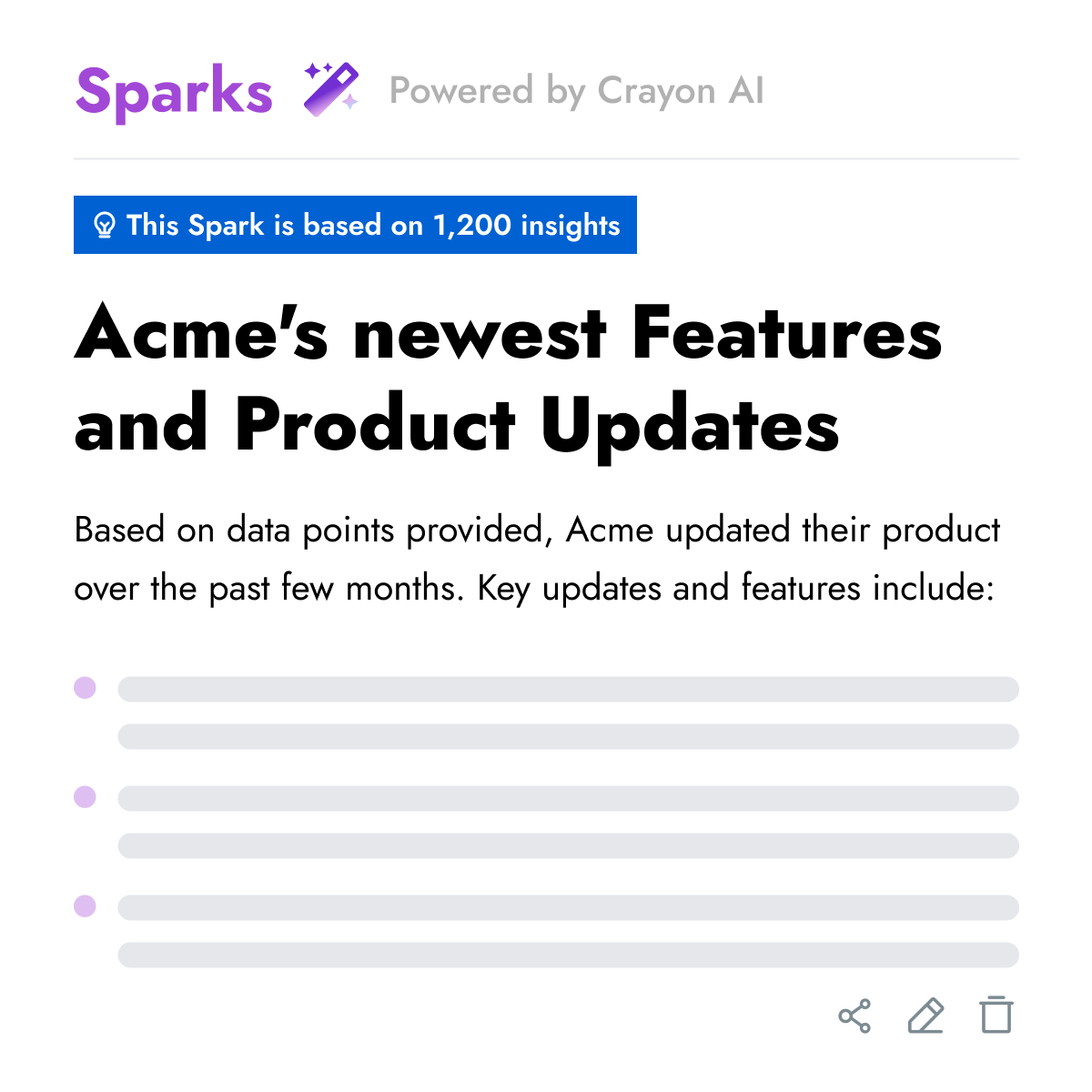
Crayon does not disclose pricing publicly; three tiers (Essentials, Professional, Enterprise) are gated behind a pricing-inquiry form. Third-party estimates via Vendr put typical enterprise deployments in the $20K–$40K/yr range, with smaller teams landing closer to $15K and larger enterprise rollouts pushing past $100K once add-ons are included.
Best for: SMB and lower mid-market teams — especially existing Semrush customers — who want automated competitor tracking and AI-generated battlecards without committing to a $20K+ Klue or Crayon contract.
Similar to: Crayon, Klue, KeepTabz.

Kompyte has historically been the most accessible entry point in the named-CI category. The product covers live tracking of competitor websites, social posts, reviews, content, and job listings; AI filters and workflows that tag and route competitor signals; and unlimited battlecards on every tier. It's owned by Semrush as of March 2022, and integrates tightly with Semrush's SEO and PPC data — useful if you're already a Semrush customer.
A bigger question hangs over Kompyte in 2026: Adobe announced the $1.9B acquisition of Semrush on November 19, 2025, and the deal closed April 28, 2026. Kompyte is now an Adobe-owned asset under the Experience Cloud umbrella. Public roadmap signals from Adobe so far emphasize Brand Visibility and Generative Engine Optimization rather than standalone CI, and feature-release cadence has visibly slowed compared to Klue and Crayon over the last six months. Buyers should weigh that uncertainty, even though the product is still actively sold and added an IcebergIQ win-loss partnership in 2025.
What separates Kompyte from Klue is price — Kompyte starts roughly an order of magnitude lower and bundles unlimited battlecards and user seats on every tier, where Klue is sold as a premium analyst-augmented platform with a $25K+ floor and per-user pricing.
Semrush subscribers receive a stacking discount, though it's unclear how that survives the Adobe integration.
Best for: Global enterprise market-intelligence and strategy teams (banking, IT services, pharma) that need multilingual news and PR aggregation across hundreds of accounts and competitors — not just a sales-battlecard tool.
Similar to: AlphaSense, Klue, KeepTabz.
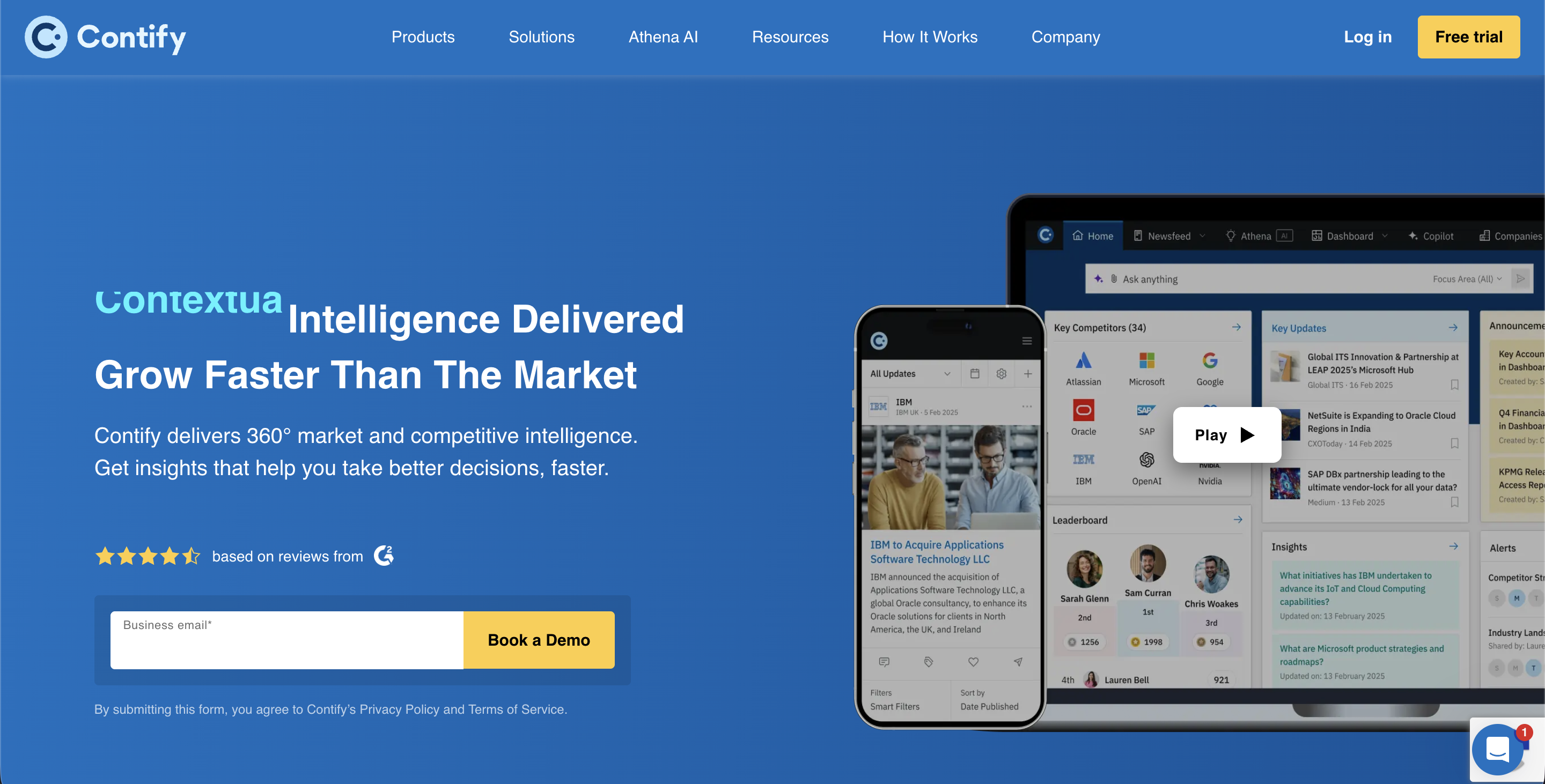
Contify is the answer if you're tracking competitors and accounts in markets where most of the signal isn't in English. The platform pulls from more than 1 million vetted sources — news wires, SEC filings, regulatory portals, job boards, and broker research — across 117+ languages with auto-translation, and applies a user-defined custom taxonomy of entities, signals, and topics to classify everything. The 2025–2026 product push is Athena AI, an agentic AI engine that answers ad-hoc questions over the curated intel layer.
Contify was named a Visionary in the inaugural 2026 Gartner Magic Quadrant for Competitive and Market Intelligence Platforms — a material analyst-credibility win for a non-US vendor and a strong signal that Contify is a serious enterprise option, not just a regional player.
What separates Contify from Klue is its center of gravity. Contify is a market and account-intelligence platform first — news, PR, regulatory feeds across thousands of entities — while Klue is a sales-enablement compete tool built around battlecards. If your team is staffed with strategy analysts who write briefings, Contify maps to that workflow. If your team is staffed with product marketers who arm reps with one-pagers, Klue does.
Contify does not disclose pricing publicly. Quotes are custom-built based on the number of companies tracked, deliverables, user seats, and feature set. Comparable enterprise market-intel deployments at this scale typically land in the $20K–$60K/yr range based on Capterra and TrustRadius listings, but Contify itself does not publish tiers.
If Klue's full suite is more than you need and you only want to track one specific slice — competitor website changes, market research and SEC filings, or social and brand mentions — these three specialized tools each cover that single capability at a fraction of the price. The trade-off is exactly what you'd expect: you'll need a second tool if you also need the slices the first one doesn't cover.
Best for: Solo operators and lean product or CI teams who only need to track competitor website changes — pricing pages, feature pages, careers pages — and don't need news, social, or review monitoring.
Similar to: Hexowatch, ChangeTower, Wachete.

Visualping is the most popular pure-play website change tracker on the market. It runs four monitoring modes (visual pixel-diff, text, element, and all), uses AI to generate plain-English summaries of what changed on every page, and supports custom AI prompts that flag only changes matching your written criteria. Visualping is used inside 85% of Fortune 500 companies for monitoring competitor and partner sites, so the underlying crawler is genuinely battle-tested.
Klue does news, social, win/loss, battlecards, AND website tracking; Visualping does only website change detection but does it more cheaply, with a real free tier and AI-summarized diffs out of the box. If web-change monitoring is the only slice of Klue you'd actually use, Visualping replaces that capability for under $25/mo.


Best for: Investment, strategy, and corporate development teams at large enterprises who need SEC filings, broker research, and expert call transcripts in one AI search workspace — with budget for $45K–$120K+/year contracts.
Similar to: Tegus (now owned by AlphaSense), Sentieo (now owned), Bloomberg Terminal, S&P Capital IQ.
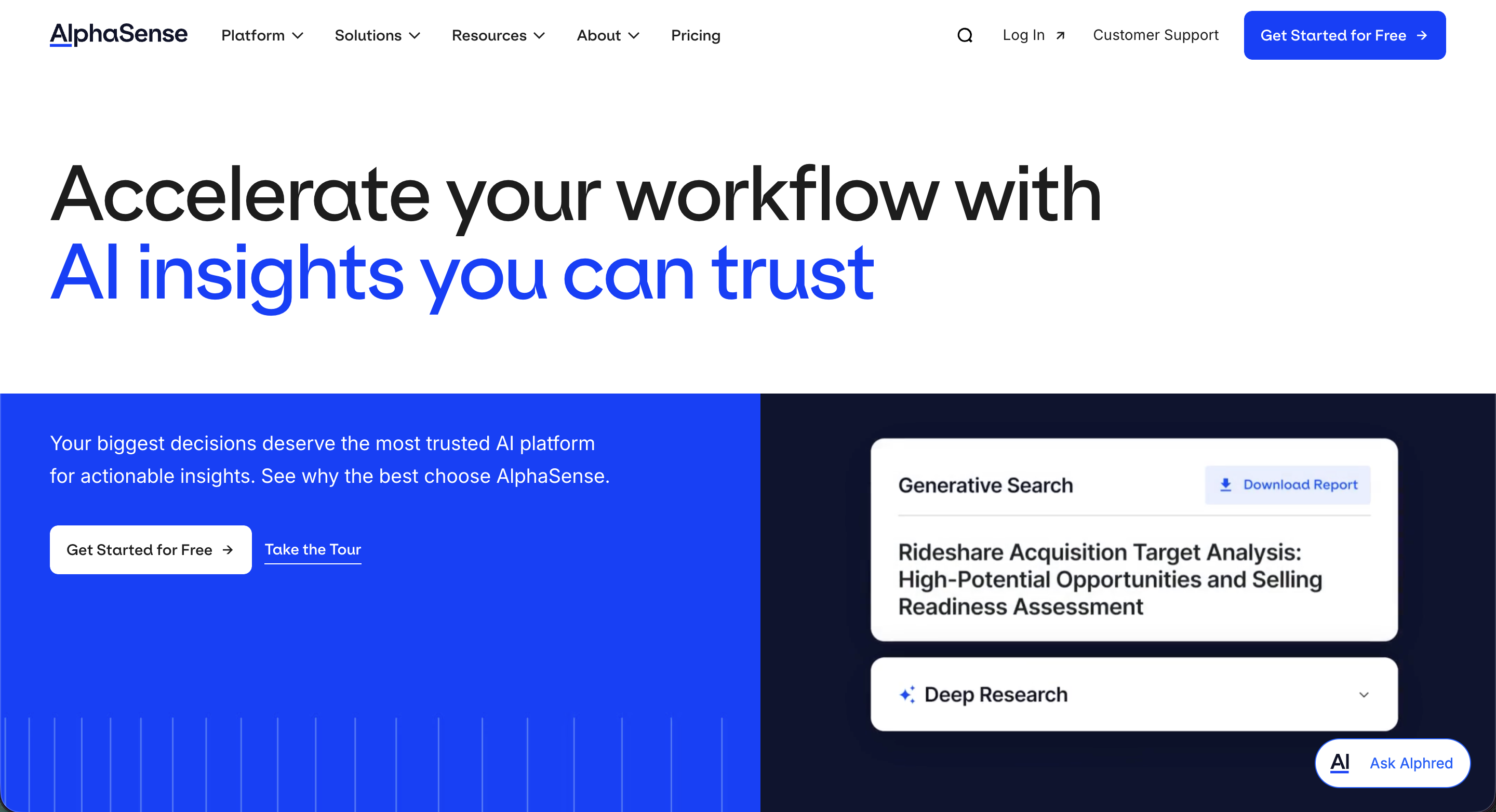
AlphaSense sits at a different center of gravity than Klue. Where Klue is built for product marketers fighting individual sales deals, AlphaSense is built for analysts modeling markets — strategy teams, corp dev, equity research, and competitive intelligence functions that need depth across SEC filings, broker research, regulatory filings, and expert call transcripts. The acquisition of Tegus for $930M in June 2024 brought 150,000+ recorded expert-interview transcripts into the platform, and Generative Search now lets analysts build primers, landscapes, and SWOTs autonomously across that corpus. AlphaSense is reportedly at ~$500M ARR and valued at $4B+, with 90% of the S&P 100 as customers.
Klue is built for product marketers fighting individual sales deals; AlphaSense is built for analysts modeling markets. Versus Klue, AlphaSense's focus is depth of financial and expert content rather than competitor battlecards. The two tools rarely compete in the same RFP — but if your CI function is really a market intelligence function staffed by analysts, AlphaSense is the better mental model than Klue.
AlphaSense does not publish pricing — sales-led only. Public references put standard licenses at roughly $10,000–$20,000 per seat per year, with a typical three-seat enterprise deployment landing around $45,000–$60,000 annually. Adding access to the Tegus expert call library pushes total spend to roughly $120,000+ per year. The largest customers run $1M+/year contracts, and recent renewals have reportedly come with ~48% YoY price increases.
Best for: SMBs, agencies, and mid-market marketing teams who need social listening, brand mentions, and sentiment monitoring across socials/news/podcasts — but don't need competitive battlecards or sales enablement.
Similar to: Mention, Mentionlytics, Meltwater (lighter weight), Sprout Social Listening.
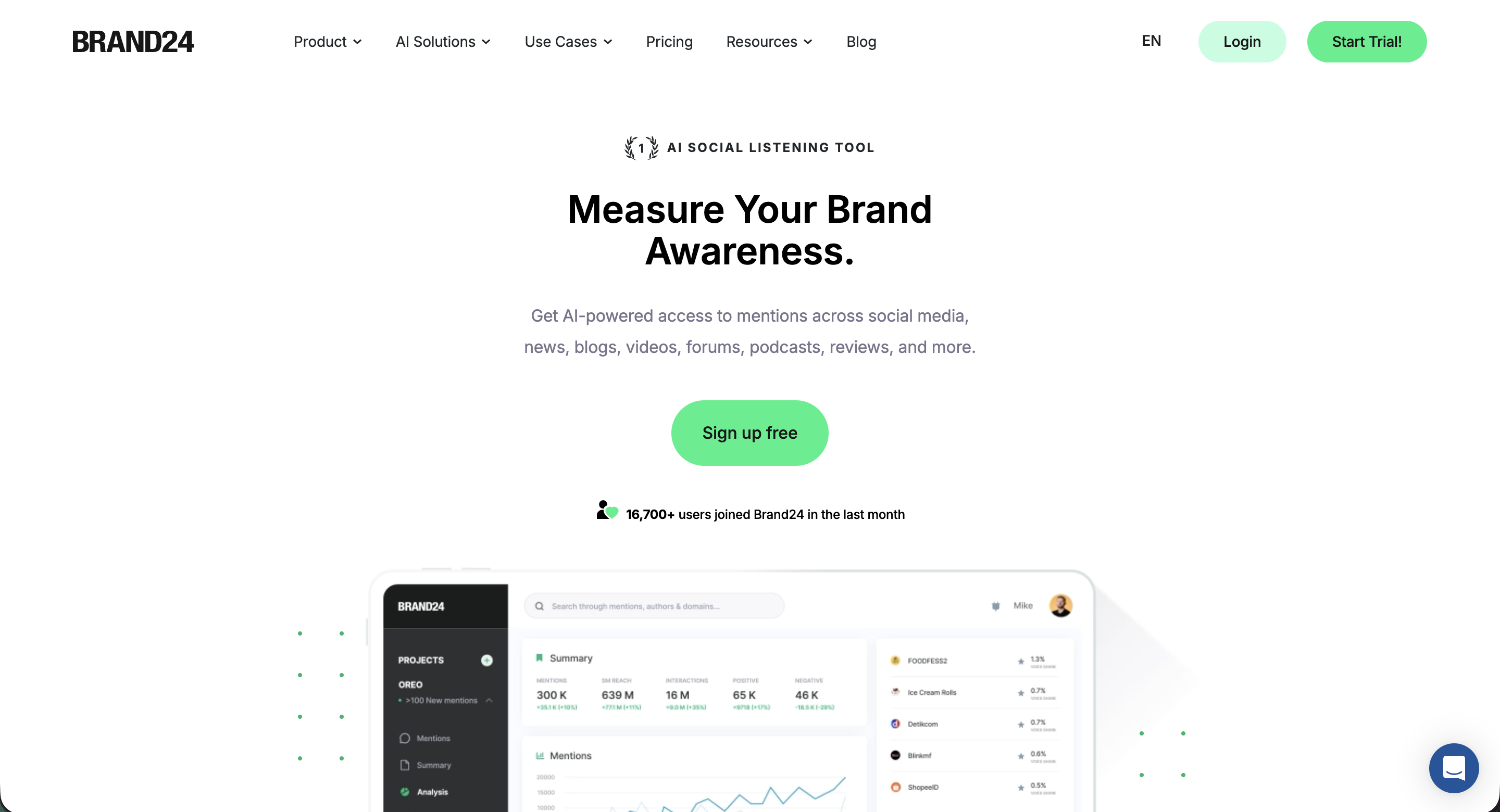
Brand24 is the social-listening slice. The Polish-headquartered company (publicly listed on the Warsaw Stock Exchange) covers brand and competitor mentions across X, Instagram, TikTok, YouTube, LinkedIn, Reddit, podcasts, news, and forums in one dashboard, with AI-powered sentiment classification across 100+ languages and an Anomaly Detection feature that auto-flags unusual mention spikes.
Brand24 has shipped AI features faster than several larger legacy competitors in 2025–2026 — including an AI Brand Assistant for natural-language Q&A over your monitoring data, and AI Chatbot Share of Voice tracking that surfaces how often ChatGPT, Claude, Gemini, and Perplexity mention your brand in responses. That AI-chatbot tracking is genuinely category-leading and ahead of larger tools like Meltwater and Cision.
Klue tracks competitors across news, web, and sales calls for product marketers; Brand24 tracks your own brand (and competitors' brands) across social, news, and podcasts for marketing and PR teams. Versus Klue, Brand24's focus is conversational and mention monitoring rather than win/loss enablement — different audience, different workflow.

14-day free trial, no credit card required.
If budget is the main constraint or you're not yet sure CI is worth a paid tool, there are two credible free or near-free paths. Both have real limitations on coverage, accuracy, and alerting — but it's useful to understand exactly what each gives you (and gives up) before assuming a paid platform is the only option.
Best for: Solo operators and tiny teams with zero budget who can tolerate a noisy, partial-coverage feed and are willing to manually triage every email.
Similar to: Talkwalker Alerts (the other free option), basic RSS readers.
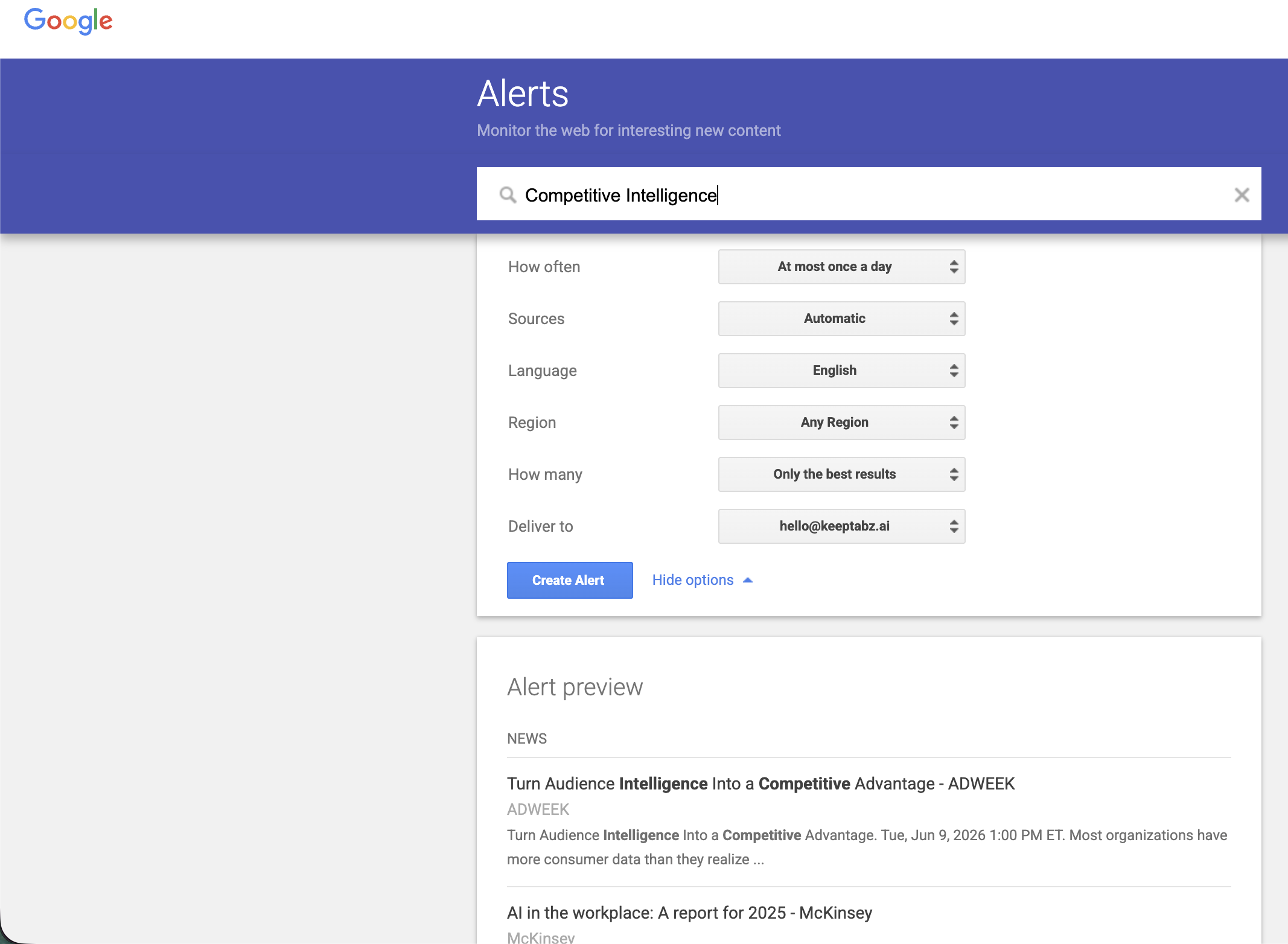
Google Alerts is the default "have you tried…" answer when a CMO asks about competitor tracking. It's free forever, runs in the background, and surfaces mentions of any keyword you set across Google's news, blog, web, and discussion indices on as-it-happens, daily, or weekly cadence. For a team with no budget and very forgiving expectations, it's a defensible starting point.
Klue scores, prioritizes, and consolidates signal across primary sources with battlecard delivery; Google Alerts gives you a raw, undifferentiated firehose with massive blind spots on social, review, and ad surfaces. The honest version: third-party tests find Google Alerts misses roughly 40% of business-relevant updates and only ~10% of returned results are actually relevant to competitive tracking. It also doesn't see Reddit comments, LinkedIn posts, ad libraries, or G2/Capterra reviews — exactly the sources where most modern competitive signal actually lives.
Free forever. No paid tier.
Best for: Strategists and operators who want one-shot, citation-backed deep dives on a specific competitor or market question and don't need always-on monitoring.
Similar to: Claude Research, Gemini Deep Research, You.com Research.
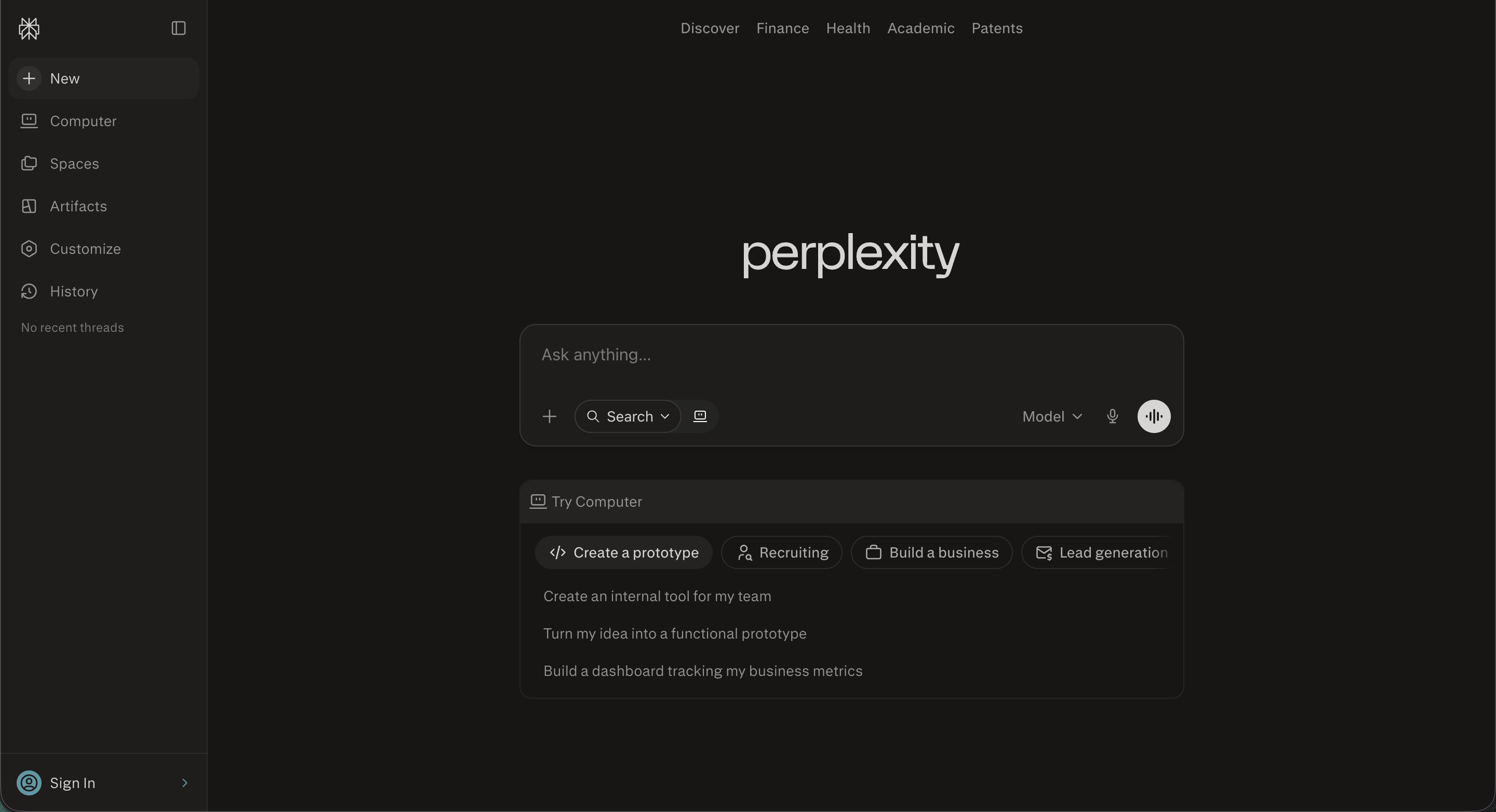
The AI deep-research products from Perplexity and ChatGPT — both available at $20/mo on Pro / Plus tiers, and $200/mo on higher-usage tiers — plan, search, and synthesize across dozens of public sources to return long-form competitor briefs with inline citations. Perplexity runs in 2–3 minutes per report; ChatGPT runs 5–30 minutes for deeper passes. For a one-off "give me a primer on competitor X" question, both are dramatically faster than manual desk research.
The catch is real, and it's the whole reason KeepTabz exists. Klue runs continuously, scores signals, and pulls from primary sources LLMs can't crawl; Deep Research is a snapshot in time, can't see the LLM-blocked sources, and gives you no alerting, scoring, or battlecard delivery. The highest-signal CI sources — LinkedIn, Reddit, G2, Capterra, ad libraries — actively block or restrict LLM crawlers, so Deep Research literally cannot see them. Reddit sued Perplexity in October 2025 over alleged scraping via Google results, which sharpens the "LLMs can't legally see Reddit" problem further. Stanford researchers separately found Perplexity fabricated roughly 26% of citations and ChatGPT roughly 40% on legal-research benchmarks, so the citations themselves still require manual verification.
Markets have become more competitive faster in the last three years than in the previous decade — 84% of B2B teams say so, and 66% of B2B deals are now actively competitive. The compelling event isn't subtle: AI is making engineering teams 2–5x more productive, which means competitors are shipping features, pricing changes, and ad campaigns faster than marketing and sales can possibly track manually. Klue solved this problem for the Fortune 500. Everyone else has been stuck choosing between Google Alerts (noisy, blind) and AI deep research (snapshot, blind in different ways).
KeepTabz is the tool we built because we needed it ourselves. Same source coverage as Klue. Same AI-driven scoring trained on real CI reasoning. Same daily digest that means your team gets the signal without anyone having to log in. Roughly 1/50th the price. 48-hour setup. An open MCP server and API so you can plug competitive data into the AI agents you're already building. No two-month implementation, no enterprise contract, no required onboarding services.
If you've read this far, you know which slice of Klue you actually need. If it's the full suite, start a 14-day free trial of KeepTabz — Lite at $49.99/mo, Core at $99.99/mo, or book a demo to get a guided walkthrough on your real competitor set.
Setup takes 48 hours — including a human QA check on every account before you go live. Pick your competitors, plug into Slack, Teams, or Discord, and let the daily digest do the work. Start your free trial.
⚠️ Disclaimer: This article was last updated on May 14, 2026. CI pricing, feature sets, and acquisition status change quickly — if you spot anything out of date, drop us a line at hello@keeptabz.ai and we'll fact-check and update.