How to Build a Tiered Competitive Watchlist (So You Stop Drowning in Updates)
Most B2B teams either track no competitors or try to track too many. Here’s a 3-tier framework you can build in 90 minutes — direct, adjacent, peripheral.
A practical framework for founders and marketers who want to track competitors without lighting their week on fire. Three tiers, three cadences, three depths — built in 90 minutes.
I recently sat down with Charles Woodin on the Geekdom Podcast, and he brought up a question I've heard a lot: How many competitors should you be tracking? What about adjacent competitors who do part of what you do, but not everything.
That got me thinking. There are two ways most B2B teams handle competitive tracking, and they both end the same way.
The first is to track nobody. You’re too busy shipping. You assume you’ll hear about big competitor moves through “the grapevine.” Six months later you’re in a deal where the prospect is comparing your pricing to a competitor you didn’t even know had launched a self-serve tier.
The second is to track everybody. You open a Notion page with 25 competitors. You set up Google Alerts for each one. By week three, your inbox has 400 unread Google Alert digests, half your “competitors” are companies with the same name that make completely unrelated products, and the whole exercise has quietly collapsed.
Both failure modes have the same root cause: you’re treating every competitor as equally important. They’re not. The fix is to stop doing that.
The fix: three tiers, three cadences, three depths
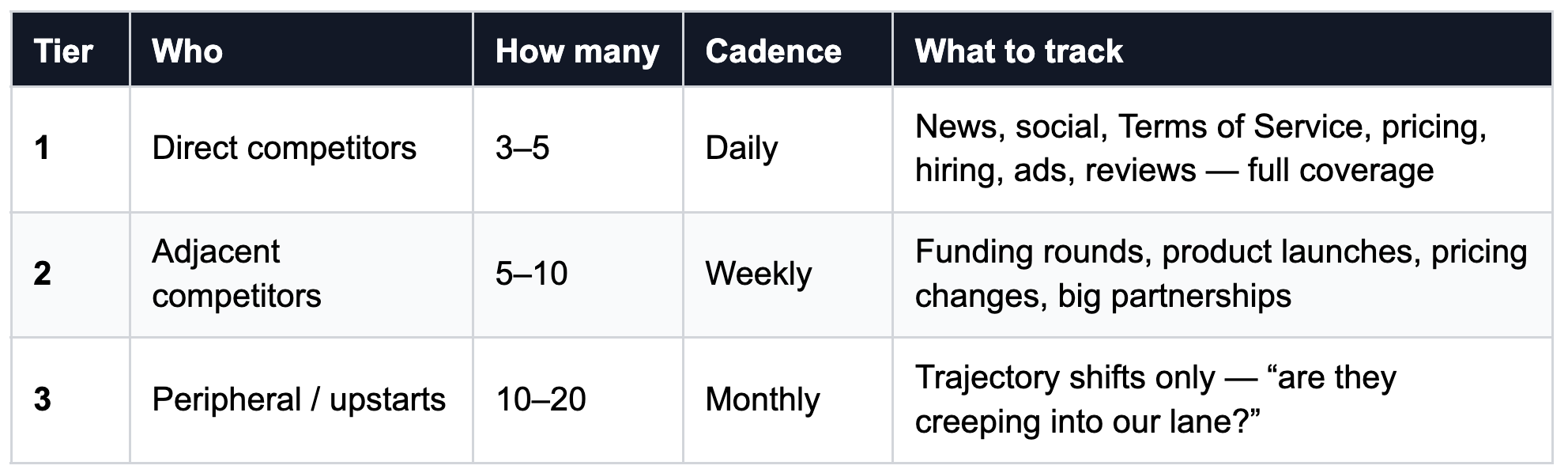
Build the watchlist as three separate groups, each with its own cadence for how often you look at it and its own depth for what you actually check.
Tier 1 — Direct competitors (3–5 max)
Daily check-ins. Full coverage. These are the names that show up in your sales deals.
You’re watching everything: news, social posts (company and exec accounts), Terms of Service edits, pricing page changes, hiring spikes, paid ad creative, review trends, navigation changes on the marketing site. If they breathe, you want to know.
The cap is critical. More than five direct competitors and you’re not really watching any of them — you’re sampling. If your gut tells you you have eight direct competitors, you probably have three direct competitors and five Tier 2s. Be honest.
Tier 2 — Adjacent competitors (5–10)
Weekly check-ins. Lighter coverage. These are the products that sit one step over from yours — different category, partly overlapping job-to-be-done, occasionally surface in deals as “the way we do it today.”
You’re watching the major moves only: funding rounds, big product launches, pricing changes, named partnership news, public ICP shifts. You don’t need to know every LinkedIn post their CEO writes. You need to know if they’re starting to point their product at your customer.
Tier 3 — Peripheral / upstart watchlist (10–20)
Monthly check-ins. Surface-level only. The question you’re asking once a month is: “Are any of these creeping into our lane?”
This is where you put fast-growing startups in adjacent spaces, well-funded players in nearby categories, and the legacy giant whose new VP of Product just announced they’re “modernizing the platform.” You don’t need real-time alerts on these. You need a once-a-month sweep that flags meaningful trajectory shifts.
The 4-question test for assigning a tier
When you’re not sure where a competitor belongs, run them through this:
Do customers mention them, unprompted, in active deals?
Are they in our exact category, or one step adjacent?
Are they growing faster than us — revenue, headcount, fundraising?
Do they have a credible roadmap into our space — public job postings, partnerships, public commentary?
Scoring: Tier 1 if (1) is yes. Tier 2 if (1) is no but (2) and (3) or (4) are yes. Tier 3 if just (3) or (4) are yes. Everyone else stays off the list.
That last point matters. Most teams’ watchlists are bloated because they treat “any company that could theoretically compete with us someday” as a tracking obligation. It isn’t. If a company doesn’t clear at least one of these four questions, they belong on a quarterly review at most — not on your daily, weekly, or monthly watchlist.
The part nobody does: promotion and demotion
A watchlist isn’t a fixed asset. It’s a queue.
The most common failure mode I see, after the initial setup, is that teams build the watchlist once and then never touch it again. A year later, two of their “Tier 1” competitors don’t exist anymore, three of their Tier 3 entries should have been Tier 1 six months ago, and the whole thing is silently lying to them.
The rule:
A Tier 3 competitor jumps to Tier 1 the moment a customer names them in a deal cycle. Not “we’re seeing them in the market.” A customer, in a real deal, said the words.
A Tier 1 competitor demotes to Tier 2 if they go 90+ days with no meaningful moves and aren’t showing up in deals. (Quiet competitors are a signal. Sometimes the signal is “they’re dead.” Sometimes it’s “they’re heads-down building the thing that kills you in Q3.” Don’t ignore them either way.)
A Tier 2 promotes to Tier 1 if their pricing, ICP, or category positioning publicly shifts to overlap yours.
Block 30 minutes on the first Monday of every month to do the shuffle. It will save you from being blindsided.
Tooling: zero budget vs. a real tool
You can run this framework with no software. Google Alerts (set narrow, with negative keywords to filter out same-name false positives), Visualping on the homepage and pricing page of each Tier 1, a Notion board for the watchlist itself, and a recurring Friday calendar block to actually look at the results. That’s enough to get you most of the value at zero cost.
The catch: the moment you have more than three or four Tier 1 competitors, this stops scaling. The diff between “the homepage changed” and “this is the change that matters” is the work. The reason teams stop doing manual CI isn’t the gathering — it’s the interpretation. There’s just too much to read.
That’s the part a real CI tool solves. KeepTabz (full disclosure: my company) was built specifically to make this framework operational at scale. The daily, weekly, and monthly cadence is baked into the product. Every signal is scored for strategic importance. The daily digest delivers the three things that actually matter to your Slack — instead of 400 alerts you’ll never open.
But the framework itself works whether you use a tool or not. Build the watchlist first. Adopt the tool when the manual version stops keeping up.
The 90-minute Friday-afternoon exercise
Here’s how to build the whole thing from scratch this week. Block 90 minutes on Friday afternoon. Bring a coffee. Open a fresh Notion doc.
Brain-dump (10 min). Write down every company you can think of who might be a competitor. Don’t filter. You want 20–40 names on the page.
Sort by Question 1 (10 min). For each name, ask: do customers mention them, unprompted, in active deals? Anyone who clears this goes in a “Tier 1 candidates” column.
Cap at five (5 min). If you have more than five Tier 1 candidates, force a ranking. The bottom of that list moves to Tier 2.
Sort the rest (20 min). For everyone left, run Questions 2, 3, and 4. Anyone who clears them goes in Tier 2 or Tier 3. Anyone who doesn’t, delete.
Define the cadence (10 min). Write down the specific time block when you’ll review each tier. Daily Tier 1 — 15 minutes with your coffee. Weekly Tier 2 — 30 minutes Friday morning. Monthly Tier 3 — first Monday, 45 minutes.
Set up the inputs (30 min). Whatever tooling you’re going to use — Google Alerts, Visualping, KeepTabz, a Slack channel for the team to drop links into — configure it now. Done is better than perfect. You’ll tune it.
Calendar the monthly shuffle (5 min). First Monday of every month, 30 minutes, recurring. This is the meeting that prevents your watchlist from rotting.
Total setup time: 90 minutes. Total ongoing cost: 15 minutes a day, 30 minutes a week, 75 minutes a month. That’s it.
Track the right ones, not the most ones
The point of competitive tracking isn’t to know everything. It’s to never be surprised. You don’t need to read every LinkedIn post your competitor’s CEO writes. You need to know when their pricing changes, when their ICP shifts, when their hiring page tells you they’re going upmarket. A tiered watchlist gets you that with a fraction of the attention.
The companies that win in 2026 aren’t the ones who track the most competitors. They’re the ones who track the right ones — at the right depth, at the right cadence, with the right framework for promoting the threats and demoting the noise.
Build the list. Work the cadence. Reshuffle every month. That’s the whole game.